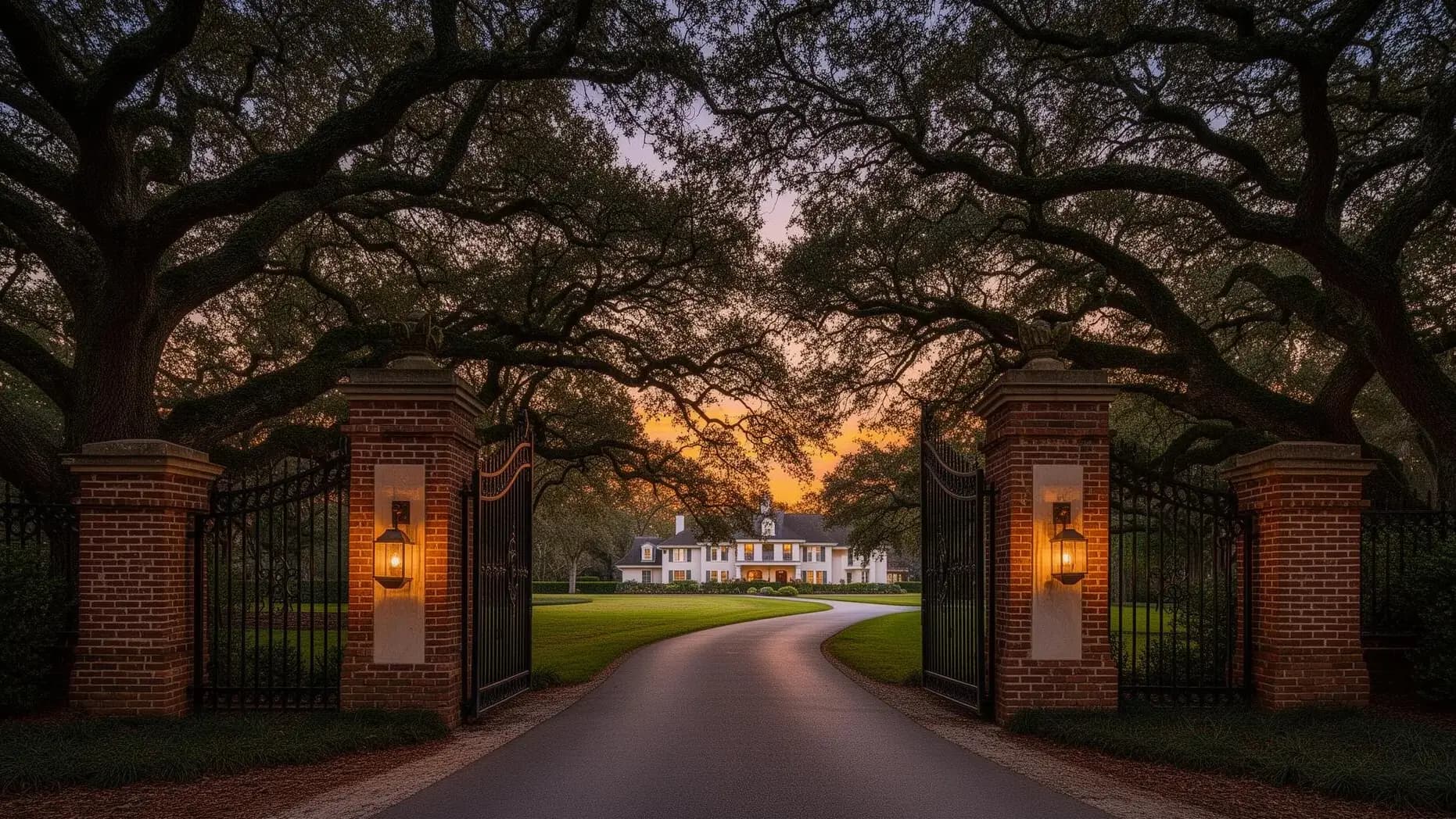
Your driveway is the first thing anyone sees when they pull up to your home. Before a buyer notices the roof, the front door, or the landscaping, their eyes are on the surface under their tires. And yet driveways are one of the most underinvested features in luxury real estate. According to the National Association of Realtors 2024 Remodeling Impact Report, exterior improvements including driveways and hardscaping consistently rank among the highest-ROI upgrades for home sellers.
In Atlanta, driveway design carries extra weight. Georgia red clay creates real engineering challenges. The humid subtropical climate means freeze-thaw cycles, intense summer heat, and heavy rain that can wash out poorly graded surfaces. And in luxury neighborhoods like Buckhead, Tuxedo Park, and Chastain Park, a driveway that looks cheap or worn stands out for all the wrong reasons.
This guide covers everything you need to know about designing, building, and maintaining a driveway that matches the quality of your home: materials, layout options, lighting, drainage, cost ranges, and how different choices affect resale value.
Driveway Material Options: A Side-by-Side Comparison
The material you choose sets the tone for the entire property. Each option has trade-offs in cost, durability, maintenance, and aesthetics. Here is how the most common luxury driveway materials stack up in the Atlanta market.
Brick Pavers
Brick pavers are the gold standard for traditional Atlanta luxury homes. They pair naturally with Georgian, Colonial, and Federal architecture. Cost runs $15 to $35 per square foot installed, depending on the pattern and brand. Clay brick is more durable than concrete brick in freeze-thaw conditions. The main maintenance task is periodic re-sanding of joints and occasional re-leveling of shifted pavers. A properly installed brick paver driveway can last 50 years or more. The classic herringbone pattern provides both visual interest and superior load-bearing capacity compared to running bond or basketweave patterns.
Natural Stone (Bluestone, Granite, Travertine)
Natural stone is the premier choice for high-end luxury estates. Bluestone offers a sophisticated blue-gray tone that complements both traditional and contemporary homes. Granite is virtually indestructible and handles heavy vehicle traffic without chipping. Travertine brings warmth but requires sealing in Atlanta's wet climate. Costs range from $25 to $60 per square foot installed. Natural stone signals quality immediately and is the material you will find on driveways at $5 million-plus estates in Tuxedo Park and Paces.
Stamped or Stained Concrete
Modern stamped concrete can mimic the look of stone, brick, or slate at a fraction of the cost. Prices range from $12 to $25 per square foot installed. It offers a uniform surface with fewer trip hazards than pavers. The downside: stamped concrete can crack over time, especially on Georgia clay that shifts seasonally. Repairs are visible because matching the original color and pattern is difficult. Sealing every two to three years extends the life and appearance. This is a solid mid-range option for homes in the $1 million to $2 million range.
Asphalt
Asphalt is the most affordable option at $3 to $7 per square foot. It provides a smooth, quiet driving surface and handles freeze-thaw well. However, asphalt reads as utilitarian, not luxury. In higher-end neighborhoods, a blacktop driveway can actually hurt your home's perceived value. If budget is a constraint, consider asphalt for the main driving surface with stone or brick borders and an apron at the entry to upgrade the appearance. Asphalt requires sealcoating every three to five years and typically needs resurfacing after 15 to 20 years.
Permeable Pavers
Permeable pavers are gaining traction in Atlanta, particularly in areas with strict stormwater management requirements. According to the EPA, permeable pavements can reduce stormwater runoff by 70% to 90%. They look identical to standard pavers but have wider joints filled with aggregate that allows water to pass through. Cost is about 10% to 20% more than standard pavers. Some municipalities in metro Atlanta offer incentives or reduced stormwater utility fees for permeable surfaces. On Georgia clay, a substantial aggregate base layer is essential for proper function.
Driveway Layout Options for Luxury Properties
The layout of your driveway affects everything from traffic flow and guest parking to the visual impact of your home's facade. In luxury real estate, the driveway is an arrival experience, not just a parking surface.
Circular Driveways
The circular driveway is the most iconic luxury layout. It creates a dramatic approach, eliminates the need for backing out, and typically features a landscaped center island. You need at least 100 feet of road frontage to accommodate a proper circular drive. The minimum inner radius should be 15 feet for comfortable vehicle turns. In Atlanta's luxury neighborhoods, circular driveways are considered a baseline expectation on properties above $2 million. The center island is your opportunity to make a statement with a specimen tree, fountain, or sculptural planting.
Motor Courts
A motor court is essentially a widened arrival area, often positioned between the home and a side-entry garage. It provides ample parking for guests, creates a stately feel, and keeps cars organized. Motor courts work particularly well on properties where the garage is not visible from the street. Size typically ranges from 30 by 30 feet to 50 by 50 feet. Materials should match or complement the main driveway. In estates with separate guest houses or detached garages, the motor court serves as a central hub connecting different structures.
Long Straight Drives with Turnaround
For properties set back from the road on larger lots, a long straight driveway with a turnaround (hammerhead or Y-shaped) near the home is a classic approach. This layout works well on lots with 200 feet or more of depth. It builds anticipation as visitors approach the home. Tree-lined drives with oaks or crepe myrtles are a quintessential Southern touch. The turnaround area should be at least 20 feet wide by 30 feet long to allow a standard vehicle to turn without backing up. Flagstone or a contrasting paver at the turnaround visually marks the arrival point.
Drainage Engineering: The Georgia Clay Challenge
If there is one thing that separates a well-built Atlanta driveway from one that fails within five years, it is drainage. Georgia red clay (technically a type of Ultisol soil, per the USDA Natural Resources Conservation Service) has extremely low permeability. Water does not drain through it. It pools on it, runs across it, and when it saturates, the clay swells and shifts.
A luxury driveway on Georgia clay needs a minimum 6-inch compacted aggregate base. Many contractors recommend 8 to 10 inches for heavy vehicle traffic areas. A geotextile fabric between the clay subgrade and the aggregate base prevents the clay from migrating into the gravel over time. French drains along both edges of the driveway channel water to a discharge point away from the home's foundation. The driveway surface itself should maintain a minimum 2% cross-slope (one-quarter inch per foot) to shed water laterally.
For properties with significant grade changes, catch basins and trench drains may be necessary. Atlanta receives roughly 50 inches of rain per year, per National Weather Service data, so designing for heavy downpours is not optional. Improper drainage is the leading cause of driveway failure in metro Atlanta. The extra investment in proper sub-base and drainage engineering pays for itself many times over in avoided repairs.
Heated Driveway Systems: When They Make Sense in Atlanta
Heated driveways are common in northern climates, but they are becoming more popular in Atlanta for specific situations. The city typically sees two to four ice events per winter and occasional snow accumulation. While that does not justify a heated system for every property, certain conditions make it worth considering.
Steep driveways are the primary use case. Many luxury homes in North Buckhead, Chastain Park, and the hilly parts of Sandy Springs sit on significant grades. When ice forms on a steep driveway, it becomes a genuine safety hazard. A hydronic heating system (hot water circulated through PEX tubing embedded in the driveway) or electric radiant mats can eliminate ice formation entirely.
Installation costs run $12 to $25 per square foot on top of the surface material cost. Hydronic systems are more expensive to install but cheaper to operate. Electric systems are simpler to install but cost more in electricity per use. Most Atlanta homeowners who install heated driveways use a snow sensor that activates the system automatically when temperature and moisture conditions indicate ice formation. Annual operating cost in Atlanta's relatively mild winters typically falls between $200 and $500, depending on system size and the number of activation events.
Borders, Edging, and Finishing Details
The details at the edges of a driveway separate professional work from average work. A contrasting border adds definition, visual interest, and structural integrity. The most common approach in luxury Atlanta homes is a darker or lighter paver border that frames the main driving surface. Belgian block (granite cobblestone) borders are a classic choice that adds old-world character. Concrete curbing with a bull-nose profile provides a clean, modern edge.
Where the driveway meets the street (the apron), material quality matters most because it is the first thing visitors see. Many homeowners upgrade the apron to stone even if the main driveway is concrete. The apron is also where drainage issues often surface, so it should be engineered with a slight dip and proper grading to prevent water from running down the driveway toward the home.
Entry columns or pilasters at the driveway entrance are another signature detail in Atlanta luxury design. Brick or stone columns topped with lanterns or decorative caps create an immediate sense of arrival. The column material should match or complement the home's exterior. For gated properties, the columns also house the gate hardware and intercom systems.
Driveway Lighting That Elevates Curb Appeal
Lighting transforms a driveway from a flat surface into a design feature. And in a market where most luxury home showings begin with a drive-by (often at dusk), the way your driveway looks at night can determine whether a buyer schedules a tour.
The most effective driveway lighting plans use layers. Low-voltage path lights along both edges provide safe passage and create a rhythm of warm light that guides the eye toward the home. Bollard lights or flush-mount fixtures at key points (entry, curves, turnaround) add structure. Uplighting on flanking trees or columns adds vertical drama. Recessed ground lights embedded in the driveway surface can accent the centerline or borders.
LED fixtures are the standard for new installations. They use 75% less energy than incandescent equivalents and last 25,000 to 50,000 hours, per the U.S. Department of Energy. Warm white (2700K to 3000K) is the preferred color temperature for residential luxury lighting. Smart lighting systems that integrate with your home automation allow you to program scenes, adjust brightness, and activate zones based on time of day or motion detection.
Budget for driveway lighting typically runs $5,000 to $20,000 depending on the number of fixtures, wiring complexity, and whether you are retrofitting or installing during new construction. It is one of the highest-impact curb appeal investments you can make.
Cost Ranges and Curb Appeal ROI
The return on investment for driveway improvements is difficult to isolate from other curb appeal enhancements, but exterior improvements that include driveways, walkways, and hardscaping are typically among the stronger-returning projects at resale while delivering an outsized impact on buyer perception.
Typical Driveway Costs in Metro Atlanta (2026)
- Basic asphalt (1,500 sq ft): $4,500 to $10,500 installed. Functional but not appropriate for homes above $1 million in luxury neighborhoods.
- Stamped concrete (2,000 sq ft): $24,000 to $50,000 installed. Good value for homes in the $1 million to $2 million range. Wide range of patterns and colors available.
- Brick pavers (2,500 sq ft circular): $37,500 to $87,500 installed. The most common choice for traditional luxury homes. Includes base preparation and border work.
- Natural stone (3,000 sq ft motor court): $75,000 to $180,000 installed. Premium option for estate-level properties. Includes drainage, sub-base, and finishing details.
- Add-ons: Heated system ($12-$25/sq ft extra), professional lighting ($5,000-$20,000), entry columns ($3,000-$15,000 per pair), automated gate system ($8,000-$30,000).
The key insight for sellers: buyers in the luxury market make snap judgments. A stunning driveway signals that the rest of the home has been cared for with the same attention to detail. A cracked, stained, or poorly designed driveway signals the opposite. The driveway is your curb appeal story told in 10 seconds.
Maintenance by Material: What to Expect
Every driveway material requires some maintenance to look its best over time. In Atlanta's climate, the biggest threats are pollen (spring), heat expansion (summer), leaf stains (fall), and freeze-thaw cycles (winter). Here is what each material demands.
Asphalt: Sealcoat every three to five years ($0.15 to $0.25 per square foot). Fill cracks promptly to prevent water intrusion. Expect full resurfacing at 15 to 20 years. Pressure washing once a year keeps it looking fresh.
Concrete: Seal every two to three years. Clean oil stains immediately (they penetrate quickly). Cracks should be filled with color-matched epoxy. Full replacement is typically needed at 25 to 30 years, though well-maintained concrete can last longer.
Brick pavers: Replenish polymeric sand in joints every two to three years. Re-level shifted pavers as needed (settling is normal on clay). Pressure wash annually. The big advantage: individual pavers can be replaced if damaged without affecting the surrounding surface.
Natural stone: Seal porous stones (travertine, limestone) every one to two years. Granite and bluestone require minimal sealing. Pressure wash annually with appropriate stone-safe cleaners. Natural stone develops a patina over time that many homeowners consider an asset rather than a flaw.
Frequently Asked Questions
What is the best driveway material for a luxury home in Atlanta?
The best material depends on your home's architectural style, budget, and maintenance preferences. Brick pavers and natural stone (bluestone, granite, or travertine) are the most popular choices for Atlanta luxury homes because they complement the traditional Southern aesthetic, handle freeze-thaw cycles well, and offer excellent curb appeal. Concrete with exposed aggregate or stamped finishes is a strong mid-range option. The key is matching the driveway material to the home's facade, landscaping, and overall design language.
How much does a luxury driveway cost in Atlanta?
Costs vary widely depending on material, size, and complexity. Asphalt runs $3 to $7 per square foot installed. Stamped or stained concrete ranges from $12 to $25 per square foot. Brick pavers typically cost $15 to $35 per square foot. Natural stone can run $25 to $60 or more per square foot. A typical luxury home driveway of 1,500 to 3,000 square feet might cost $30,000 to $120,000 or more depending on material choice, drainage work, and design complexity. Motor courts and circular driveways add to the total due to increased square footage and structural requirements.
Does a circular driveway add value to a luxury home?
Yes, a well-designed circular driveway can add measurable value to a luxury property. According to multiple appraisal studies, curb appeal improvements can increase perceived home value by 5% to 11%. A circular driveway improves functionality (no three-point turns), creates a grand arrival sequence, and signals luxury. The ROI depends on the quality of materials and how well the design integrates with the home and landscaping. In Buckhead and other high-end Atlanta neighborhoods, circular driveways are considered a standard feature on properties above $2 million.
How do you handle drainage for a driveway on Georgia red clay?
Georgia red clay is notorious for poor drainage because of its high density and low permeability. A properly engineered luxury driveway on clay soil requires a compacted gravel sub-base (typically 6 to 8 inches), French drains along the edges, proper grading with a minimum 2% slope away from the home, and sometimes a geotextile fabric layer between the clay and the sub-base to prevent migration. Permeable pavers are an increasingly popular option because they allow water to filter through the surface rather than pooling or sheeting toward the home.
Are heated driveways worth it in Atlanta?
Atlanta gets ice storms and occasional snow, but not enough to justify a heated driveway for most homeowners based on climate alone. However, if your driveway has a steep grade, if you have elderly family members, or if you simply want to eliminate the hassle of ice and snow removal, a hydronic or electric radiant heating system can be a worthwhile addition. Installation costs range from $12 to $25 per square foot on top of the driveway material cost. Operating costs are modest since you would only run the system a few times per winter.
What driveway layout works best for large luxury homes?
The most common layouts for large luxury homes in Atlanta are circular driveways, motor courts, and long straight drives with a turnaround area. Circular driveways work well on properties with at least 100 feet of frontage and provide a natural flow for arriving and departing vehicles. Motor courts are ideal for homes with side-entry or rear-entry garages, offering ample guest parking. The right layout depends on your lot dimensions, garage placement, home orientation, and how you want the arrival experience to feel.
How should I light my luxury driveway?
Driveway lighting serves three purposes: safety, security, and aesthetics. The most effective approach layers multiple types of lighting. Low-voltage path lights along both edges provide guidance and ambiance. Bollard lights or pillar-mounted fixtures at the entry create a welcoming threshold. Uplighting on nearby trees adds drama. Recessed ground lights can accent borders or curves. LED fixtures are the standard for efficiency and longevity. A lighting designer can create zones controlled by timers or smart systems that adjust brightness based on time of day.
How long do different driveway materials last in Atlanta's climate?
Longevity varies by material and maintenance. Asphalt typically lasts 15 to 20 years before needing resurfacing. Poured concrete lasts 25 to 30 years with proper sealing. Brick pavers can last 50 years or more with periodic re-leveling and joint sand replacement. Natural stone (granite, bluestone) can last a lifetime with minimal maintenance. Atlanta's freeze-thaw cycles, summer heat, and heavy rain all affect driveway longevity, so proper installation with adequate sub-base and drainage is more important than the surface material itself.
Selling Your Atlanta Luxury Home?
Curb appeal starts at the street. If you are preparing to list your luxury home and want guidance on which exterior improvements will maximize your return, we can help.
Get a Curb Appeal Consultation
Sources
- National Association of Realtors (NAR) - 2024 Remodeling Impact Report. Exterior improvement ROI data and buyer perception research.
- U.S. Environmental Protection Agency (EPA) - Permeable pavements guidance, stormwater runoff reduction data.
- USDA Natural Resources Conservation Service - Georgia soil classification and drainage characteristics for Ultisol soils.
- U.S. Department of Energy - LED lighting efficiency data, residential lighting guidance.
- National Weather Service (Atlanta forecast office) - Annual precipitation data for metro Atlanta.
- Interlocking Concrete Pavement Institute (ICPI) - Paver installation standards, sub-base recommendations, and permeable paver specifications.
Cost estimates reflect Atlanta metro area pricing as of early 2026 and may vary based on material availability, contractor, and project complexity. This article is for informational purposes only and does not constitute professional engineering or construction advice.
Disclaimer: This article is for informational purposes only and does not constitute professional construction, engineering, or financial advice. Costs, materials, and building codes are subject to change. Always consult with licensed contractors, engineers, and your local building department before beginning driveway construction or renovation. The Luxury Realtor Group is a real estate brokerage and does not provide construction or engineering services.