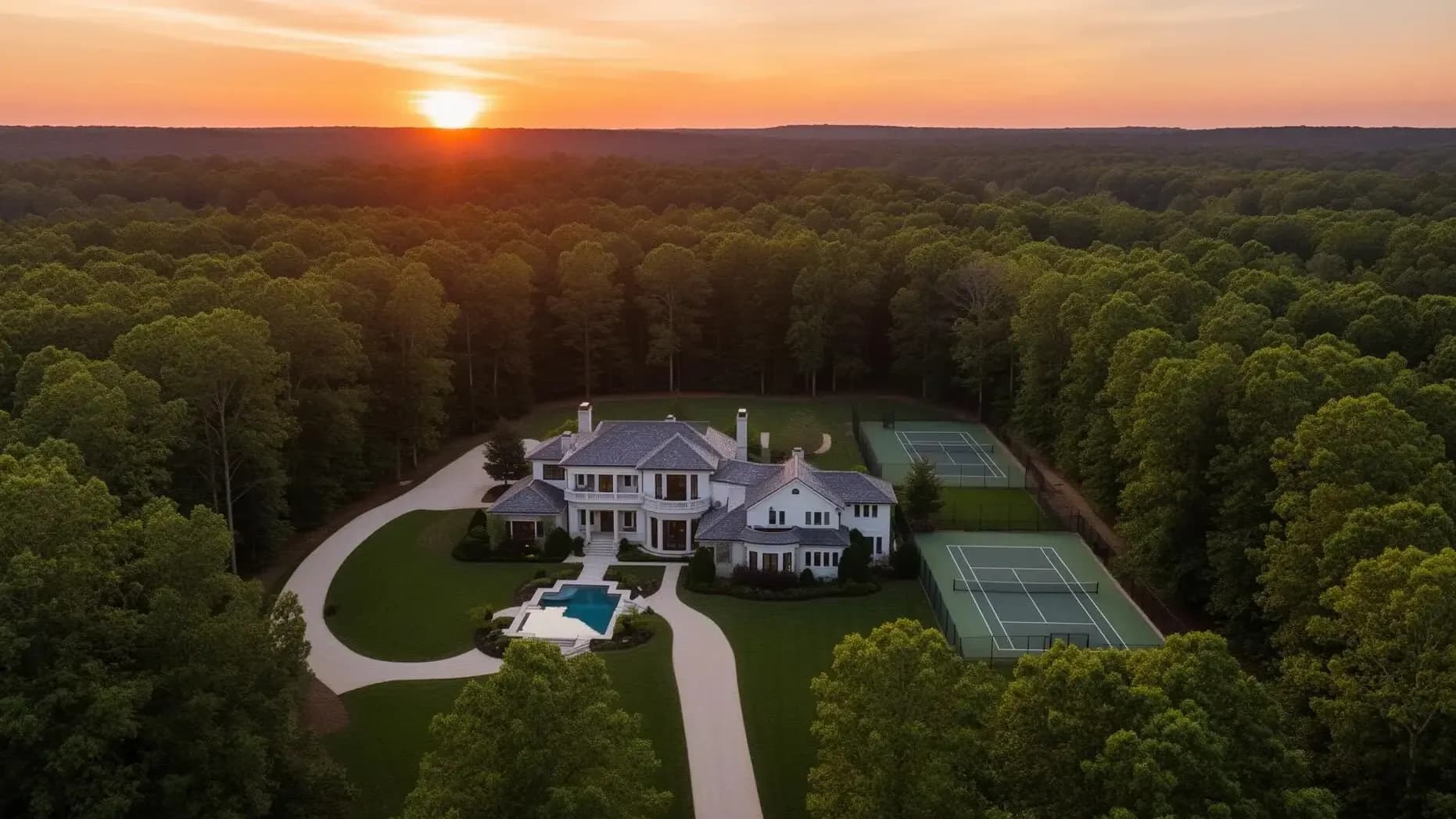
A private tennis court is one of the most specific and consequential amenity decisions an Atlanta luxury homeowner can make. Done right, on a lot that can accommodate it, with a quality surface and proper drainage, a court transforms how you live in your home and, in the right market, meaningfully supports its value. Done wrong, cramped onto a lot that is too small, built with inadequate drainage, or installed without proper permitting, it becomes an expensive liability that complicates resale.
According to the American Sports Builders Association (ASBA), the construction trade organization for sports facility builders, residential tennis court construction has grown consistently over the past decade as affluent homeowners seek to bring club-level amenities to their private properties. For those weighing a club membership against building at home, our private club fee comparison sets out what each Atlanta club actually costs to join. The addition of pickleball has accelerated this trend: a court that previously served tennis players now serves the most rapidly growing sport in America, expanding the buyer profile for properties with courts.
Atlanta is a strong market for private courts. The United States Tennis Association (USTA) consistently ranks Georgia among the top tennis-participation states in the South, and Atlanta's affluent suburbs, Buckhead, Sandy Springs, Dunwoody, Milton, and Johns Creek, have a high concentration of active tennis and pickleball players. The challenge is Atlanta's specific environmental conditions: Georgia's heavy clay subsoil, the region's significant rainfall (approximately 50 inches per year on average), and the summer heat all require specific design choices that differ from courts built in drier climates.
This guide covers every major decision point: surface options, site requirements, Georgia-specific drainage considerations, costs, permitting, maintenance, and the realistic ROI picture for Atlanta luxury properties.
Surface Options: Har-Tru Clay, Hard Court, and Grass
The surface is the most fundamental choice in tennis court construction. It determines how the ball plays, how the surface holds up to Atlanta's climate, and what ongoing maintenance it requires.
Har-Tru Clay (Green Clay)
Har-Tru is the dominant outdoor clay surface in the Eastern United States and the most popular choice for private courts in Atlanta. Made from crushed metabasalt stone, Har-Tru produces a slower game with higher ball bounce, classic clay court conditions that reward baseline play and topspin. It is significantly easier on joints than hard surfaces, which matters for players over 40 who want to continue playing without the wear that asphalt and concrete impose on knees and hips. The surface stays cooler than hard courts in direct sun, an important characteristic for Atlanta's summer play. The tradeoff is maintenance: Har-Tru requires daily brushing and rolling during the season, irrigation (typically automated), and annual resurfacing with fresh material. A quality Har-Tru installation for Atlanta runs $80,000 to $130,000 complete, including drainage, irrigation, fencing, and line marking.
Asphalt Hard Court with Acrylic Surface
Asphalt hard courts with an acrylic color coating (the surface type used at the US Open and most public parks) are the most common choice nationally and a strong option for Atlanta when built correctly. Hard courts play faster than clay, with lower bounce, which suits players with big serves or net games. They require no irrigation and very little day-to-day maintenance. The challenge in Atlanta is the acrylic surface's heat absorption, a dark blue or green hard court can reach 130 to 150 degrees Fahrenheit in direct July or August sun, making midday summer play uncomfortable. Lighter court colors and reflective acrylic coatings mitigate this. Cost runs $60,000 to $100,000 for a quality installation with proper base preparation, drainage, fencing, and LED lighting. Resurfacing every 6 to 8 years adds $8,000 to $20,000 as a recurring cost.
Cushioned Hard Court (Post-Tensioned Concrete)
Post-tensioned concrete courts with cushioned acrylic surface systems (such as Plexicushion or DecoTurf Cushion) offer the playability benefits of clay, slower game, higher bounce, and joint comfort, on a hard surface that requires clay-court-level maintenance. These are the premium hard court option and are common at private clubs and high-end residential installations. Post-tensioned concrete resists cracking better than standard asphalt over Georgia's clay soil movement. The cushioned acrylic top coat is applied in multiple layers to achieve the desired pace and feel. Cost runs $100,000 to $180,000 for a complete installation. This is the surface choice if you want hard court durability with clay court playability and you do not want to deal with clay maintenance.
Grass Courts
Grass tennis courts, the surface of Wimbledon, are extremely rare in private residential settings in Atlanta and throughout the Southeast. Maintaining a grass court requires near-daily mowing, rolling, watering, and reseeding during the playing season, and the warm-season grasses that survive Georgia summers (bermuda, zoysia) do not provide the same playing characteristics as the cool-season bentgrass or ryegrass surfaces used at Wimbledon. Georgia's summer heat and humidity make high-quality grass court maintenance exceptionally difficult. For all practical purposes, grass courts are not a realistic option for Atlanta residential construction.
Georgia Clay Subsoil: The Drainage Imperative
Atlanta's geological foundation, the Georgia Piedmont's red clay soils, is the single most important site-specific factor in Atlanta tennis court construction. Cecil clay, the predominant soil type across most of the Atlanta metropolitan area, has very low permeability: it absorbs water slowly and holds it near the surface, which is why Georgia clay lawns puddle after heavy rain and dry out slowly.
For a tennis court built on Georgia clay, drainage is not a nice-to-have, it is the difference between a court that is playable 24 hours after rain and one that sits wet for three or four days. The ASBA's construction guidelines for courts on poor-draining soils recommend a perforated drain pipe grid embedded in a layer of clean crushed stone beneath the court's base material. This subsurface drainage system intercepts water before it can saturate the court base and routes it to a daylight outlet or French drain system on the property.
For Har-Tru clay courts specifically, the drainage design matters even more because the clay surface itself temporarily holds moisture after rain, it is designed to be slightly moist for proper playability. Without effective subsurface drainage pulling water away from the base, a Har-Tru court after a heavy Atlanta thunderstorm can become waterlogged and require multiple days to return to playable condition. Proper drainage engineering can reduce that recovery time to 6 to 12 hours.
On sloped lots, which are common in Buckhead, Sandy Springs, and the hilly Atlanta suburbs, grading for the court site requires cut-and-fill work that can add $10,000 to $30,000 to the project cost depending on the degree of slope. A competent court builder will engineer the site grade to provide natural sheet drainage across the court surface in addition to the subsurface drainage system.
Full Cost Breakdown: Atlanta Tennis Court Construction (2026)
- Site preparation and grading: $8,000 to $30,000+. Higher end for sloped lots or sites requiring significant cut-and-fill. Includes Georgia clay drainage engineering.
- Subsurface drainage system: $5,000 to $15,000. Perforated pipe grid in gravel bed. Non-negotiable on Atlanta clay soils for any quality installation.
- Har-Tru clay surface (complete): $40,000 to $70,000 for the surface system including base, stone, irrigation, and lines. Installed total with site prep: $80,000 to $130,000.
- Asphalt hard court (complete): $35,000 to $55,000 for the surface system. Installed total with site prep: $60,000 to $100,000.
- Post-tensioned concrete with cushion (complete): $65,000 to $110,000 for the surface system. Installed total: $100,000 to $180,000.
- Perimeter fencing (12-14 ft chain-link or decorative): $8,000 to $25,000. Decorative powder-coated aluminum fencing costs significantly more but is the appropriate choice for luxury properties.
- LED sports lighting (4-6 pole system): $15,000 to $35,000 installed. LED systems have largely replaced metal halide due to lower energy cost and better color rendering. Essential for evening play.
- Pickleball line addition: $500 to $2,000 for lines and net post hardware. Minimal incremental cost on a new build.
- Shade structure or pavilion: $20,000 to $60,000+ for a courtside covered seating area. Increasingly common on luxury installations.
Permitting in Buckhead, Sandy Springs, and Milton
Permitting requirements for tennis courts in Atlanta-area jurisdictions are real and non-trivial. Any buyer or homeowner planning a court should factor permitting time (typically 4 to 12 weeks depending on jurisdiction) and cost into the project plan.
City of Atlanta (including most of Buckhead): Requires a land disturbance permit for any project that disturbs more than 10 cubic yards of soil, well below any tennis court project's impact. The application must include a site plan, grading plan, erosion control plan, and stormwater management documentation. The City of Atlanta's Department of City Planning processes these permits, with typical timelines of 6 to 10 weeks. Fencing that exceeds 6 feet in height (tennis court fencing typically runs 10 to 12 feet) may require a variance or special use permit in residential zones.
Sandy Springs: Sandy Springs has its own permitting process since incorporating in 2005. Land disturbance permits are required, with stormwater management a key review element. The city has been active in enforcing stormwater runoff regulations, so the drainage engineering documentation must be solid. Sandy Springs typically processes these permits in 4 to 8 weeks for straightforward residential projects.
Milton: Milton is the most rural-feeling and lot-size-generous of Atlanta's northern suburbs, with many properties on 1 to 5+ acre parcels where tennis court siting is relatively straightforward. Milton's Community Development Department handles land disturbance permits, and the city's larger average lot sizes mean setback compliance is generally less challenging than in Buckhead or Sandy Springs. However, Milton's stormwater ordinance is specific and must be addressed in the permit application.
Beyond government permits, HOA architectural review is a parallel approval process in most Buckhead and Sandy Springs neighborhoods. HOA covenants may specify limitations on impervious surface percentage, fence height, court colors, or lighting. Some HOAs require neighbor notification and response periods. Buyers purchasing a property specifically for the ability to build a tennis court should review HOA covenants carefully before closing.
Lot Size Requirements and Setback Calculations
The USTA's court construction guidelines specify a minimum recommended court site of 60 feet wide by 120 feet long, which includes the regulation court dimensions (36 by 78 feet for singles) plus mandatory run-out zones. In practice, most court builders recommend 66 by 132 feet as the minimum comfortable footprint, with more space behind the baselines improving the playing experience for fast-moving players.
In Atlanta's residential zones, typical rear and side setback requirements range from 5 to 25 feet depending on the jurisdiction and zoning classification. Applying these setbacks to the court footprint means most lots below 0.5 acres will struggle to accommodate a regulation court without significant setback variances. On a 0.4-acre lot with standard 15-foot side setbacks, you are working with approximately 70 to 90 feet of rear yard width in many Buckhead and Sandy Springs neighborhoods, tight but potentially workable depending on the specific lot geometry.
Lots of 0.75 acres or more generally have enough room to position a court comfortably. Estate-scale properties of 1 to 2+ acres, common in Tuxedo Park, Mount Paran, and north Sandy Springs, provide ample room for a court with proper setbacks, landscaping buffers, and courtside amenities.
Buyers specifically searching for a property to add a court should have their real estate agent flag lot dimensions in addition to acreage, since a long narrow lot can be just as constraining as a small square lot.
Maintenance by Surface Type
Ongoing maintenance is a real cost that belongs in any honest budget analysis for a private court. Atlanta's climate, 50 inches of annual rainfall, hot humid summers, and active biological growth, makes maintenance requirements higher than in drier climates.
Har-Tru clay: The highest-maintenance surface option. During the playing season (roughly March through November in Atlanta), the court should be brushed and rolled every day or every other day to maintain surface evenness. Automated irrigation runs daily to keep the surface appropriately moist. Lines require repainting several times per season as the clay wears them down. Annual resurfacing with fresh Har-Tru material ($3,000 to $6,000) restores the surface's depth and playing characteristics. Total annual maintenance cost for a Har-Tru court in Atlanta: $2,500 to $6,000 including irrigation water, materials, and contractor services.
Asphalt hard court: Much lower ongoing maintenance. Clean the surface once or twice per year with a court cleaner and a pressure washer. Repair cracks as they develop (small cracks left unaddressed grow under freeze-thaw cycles; Atlanta's mild winters minimize this but do not eliminate it). Algae and mildew growth in shaded areas is an Atlanta-specific challenge; periodic treatment with appropriate cleaners keeps it manageable. Full resurface and repaint every 6 to 8 years: $8,000 to $20,000. Annual ongoing maintenance: $500 to $2,000.
Post-tensioned concrete with cushion: Intermediate maintenance between the two above. The concrete base essentially never needs replacement under normal conditions. The cushioned acrylic coating requires periodic cleaning and eventual reapplication every 8 to 12 years ($12,000 to $25,000 for a full resurface). Annual ongoing maintenance: $800 to $2,500.
ROI vs. Lifestyle Value: An Honest Assessment
Private tennis courts do not typically deliver dollar-for-dollar return on investment at resale. Industry data from ASBA practitioners and luxury real estate professionals consistently shows that a well-built court on a well-suited property adds $50,000 to $150,000 in perceived value, meaningfully less than the $80,000 to $200,000 construction cost in most cases. The gap narrows at higher price points: a court on a $5 million estate property where buyers expect every amenity contributes more proportional value than the same court on a $1.5 million home.
The honest framing is this: build a court because you and your family will use it and value it, not primarily as an investment. If you play tennis or pickleball multiple times per week, the court pays for itself in club membership savings (Atlanta-area private tennis club memberships run $5,000 to $15,000 per year), convenience value, and the genuine pleasure of playing at home without reserving court time. If you play occasionally and are building primarily to enhance resale value, the math is unlikely to work in your favor.
On the buying side, purchasing a home that already has a court, the calculus is different. A well-maintained court on a suitable property narrows the field of comparable properties and can be a differentiating feature in a competitive market. Buyers who want a court should look for properties where the court was properly permitted, built to quality standards, and has been maintained. A neglected court with cracked surfaces, broken fencing, or overgrown surrounds is a liability, not an asset, budget $15,000 to $50,000 for renovation when evaluating properties with courts in poor condition.
Frequently Asked Questions
What is the minimum lot size needed for a private tennis court in Atlanta?
A standard regulation tennis court measures 60 feet wide by 120 feet long (36 by 78 feet for the court itself, with the additional space representing required buffer and run-out zones per USTA specifications). In practice, most court builders recommend a minimum site footprint of 66 feet by 132 feet to accommodate comfortable play and fencing. On a typical residential lot in Buckhead or Sandy Springs, this means you need at least a half-acre lot with appropriate setbacks to comfortably accommodate a tennis court. An acre or more is preferable if you want the court positioned well relative to the house, landscaping, and property lines. Lots smaller than 0.4 acres will face significant challenges fitting a regulation court within typical Atlanta-area setback requirements.
How much does a private tennis court cost in Atlanta?
A full tennis court in the Atlanta area typically costs between $60,000 and $200,000 or more, depending heavily on surface type, site conditions, fencing, lighting, and finishing quality. A basic asphalt hard court with standard chain-link fencing and no lighting typically costs $60,000 to $90,000. A Har-Tru clay court with proper drainage and irrigation runs $80,000 to $130,000. A premium installation with decorative fencing, LED sports lighting, seating area, and premium post-tensioned concrete surface can reach $150,000 to $200,000 or more. Georgia clay subsoil, prevalent across Atlanta's Piedmont, requires careful drainage engineering that adds cost compared to sites with better natural drainage. Grading and soil preparation on a sloped lot can add $10,000 to $30,000 or more to the base court cost.
What is Har-Tru clay and is it right for Atlanta?
Har-Tru is a brand name for a green clay tennis court surface made from metabasalt, a natural crushed green stone. It is the dominant outdoor clay court surface in the Eastern United States and is what most club clay courts in Atlanta are built on. Har-Tru plays slower than hard courts, with higher ball bounce and more topspin-friendly conditions. It is easier on joints and bodies than asphalt or concrete surfaces, which is a significant consideration for older players or those with joint issues. In Atlanta's climate, Har-Tru requires regular watering (automated irrigation is standard in any quality installation), brushing, and line maintenance. The surface needs periodic topping with fresh Har-Tru material and regular rolling. Annual maintenance costs for a Har-Tru court typically run $2,000 to $5,000, including irrigation water costs during the playing season.
What does Georgia clay subsoil mean for tennis court construction?
Atlanta sits on the Georgia Piedmont, characterized by heavy red clay subsoil (known as Georgia red clay or Cecil clay) that has notoriously poor drainage. This subsoil does not absorb water efficiently, which creates two problems for tennis courts: surface flooding during rain events, and frost heave risk (though minimal in Atlanta's mild winters). A quality court installation in Atlanta must include a full drainage system below the surface, typically a perforated drain pipe grid in a gravel bed, to move water away from the court quickly after rain. For Har-Tru clay courts, the drainage design is especially important because a waterlogged clay surface can take days to recover without proper subsurface drainage. Skimping on drainage engineering is the most common mistake in Atlanta tennis court construction and leads to expensive repairs within a few years.
Do I need a permit to build a tennis court in Atlanta or Buckhead?
Yes, tennis court construction requires permits in virtually all Atlanta-area jurisdictions. In the City of Atlanta (which includes Buckhead), a land disturbance permit is required for any grading that moves more than 10 cubic yards of material, which any tennis court installation will far exceed. A building permit may also be required for the fencing structure and any covered structures (pavilions, shade structures). Sandy Springs, Milton, Johns Creek, and other Atlanta-area municipalities have similar requirements. Additionally, most residential neighborhoods with HOAs have architectural review requirements that must be satisfied before a tennis court can be built. The permitting process typically requires site plans showing the court's position, grading plan, stormwater management plan, and fencing details. Your court builder should be familiar with local requirements, but verify that all necessary permits are in place before construction begins.
Can I add pickleball lines to a tennis court?
Yes, and it has become extremely common. A regulation pickleball court measures 20 feet wide by 44 feet long, which fits comfortably within a standard tennis court. Most court builders now offer dual-sport line marking as standard, pickleball lines in a contrasting color (typically yellow or white on a court with a different base color) applied over or alongside the tennis court lines. A single tennis court can accommodate two pickleball courts side by side. For a new construction project, adding pickleball lines costs very little incrementally, typically $500 to $2,000, and adds significant utility given pickleball's popularity across Atlanta's affluent communities. The net post system requires separate pickleball net posts (or a combo post system), which adds $400 to $1,500 for quality hardware.
What about indoor tennis courts for Atlanta homes?
Indoor tennis courts are rare in residential construction in Atlanta due to the significant cost and structural requirements. A standard indoor tennis court requires a building footprint of at least 7,200 square feet (60 by 120 feet) with interior ceiling clearance of 30 to 40 feet. Construction costs for a dedicated indoor court building typically start around $400,000 to $600,000 and can exceed $1 million for premium construction. In Atlanta's climate, where outdoor play is possible roughly 10 to 11 months per year with appropriate court surface and shelter design, the cost-benefit case for an indoor court is very difficult to justify except for the most serious players or properties where outdoor space is genuinely constrained. A covered outdoor court, a shade structure or partial enclosure that provides sun and light rain protection, is a far more practical intermediate option at $30,000 to $80,000.
How do I maintain a private tennis court in Atlanta?
Maintenance requirements vary significantly by surface type. A Har-Tru clay court requires the most ongoing attention: daily or every-other-day brushing and rolling during the playing season, automated irrigation to keep the surface slightly moist (critical for playability and surface binding), monthly line maintenance and repainting as lines fade, and annual or biannual resurfacing with fresh Har-Tru material. A hard court (asphalt or concrete) requires annual cleaning, crack repair as needed, and periodic resurfacing with an acrylic coating every 6 to 8 years (cost $8,000 to $20,000 for a full resurface and repaint). Fencing requires periodic tensioning and eventual replacement, and LED sports lighting systems require bulb or fixture maintenance. Annual all-in maintenance costs range from $2,000 to $6,000 for most Atlanta private courts.
Does a private tennis court add value to a luxury home?
A private tennis court can add value to the right home in the right market, but it does not add value dollar-for-dollar in most cases. According to industry data from the American Sports Builders Association and real estate practitioners who specialize in luxury properties with sports amenities, a well-built tennis court on an appropriate luxury property typically adds $50,000 to $150,000 in perceived value, less than its construction cost in most cases. The value contribution is highest when the home is already at a price point where buyers expect exceptional amenities ($3 million+), the lot size makes the court proportional rather than cramped, and the installation is high quality with good fencing and lighting. A poorly built court, an cramped lot, or a property at a price point where buyers do not expect sports amenities can actually create a neutral-to-negative perception, some buyers see maintenance costs and ongoing obligation rather than a lifestyle asset.
Looking for a Property with a Court, or Planning to Build?
Whether you are searching for a home that already has a tennis court or evaluating which properties have the lot dimensions and HOA allowances to accommodate one, our team can help you find the right property and think through the details.
Talk to an Atlanta Luxury Specialist
Sources
- United States Tennis Association (USTA), Court construction guidelines, minimum dimension specifications, and surface recommendations.
- American Sports Builders Association (ASBA), Construction standards for tennis courts, drainage guidelines for clay soils, and surface specification data.
- City of Atlanta Department of City Planning, Land disturbance permit requirements, setback regulations, and fence height ordinances.
- Sandy Springs Community Development Department, Permitting requirements and stormwater ordinance for Sandy Springs residential projects.
- Milton Community Development Department, Land disturbance permit and stormwater requirements for Milton residential construction.
- National Weather Service (Atlanta), Annual precipitation data and seasonal temperature normals for the Atlanta metropolitan area.
- Georgia Cooperative Extension Service, Georgia Piedmont clay soil characteristics and drainage data.
Cost estimates reflect Atlanta metro area pricing as of early 2026 and may vary based on site conditions, contractor, and material availability. Permitting requirements are subject to change; verify current requirements with your local jurisdiction. This article is for informational purposes only.
Disclaimer: This article is for informational purposes only and does not constitute professional construction, engineering, legal, or financial advice. Building codes, permit requirements, and zoning regulations are subject to change. Always consult with licensed contractors, engineers, and your local building department before beginning construction. The Luxury Realtor Group is a licensed Georgia real estate brokerage and does not provide construction or engineering services.