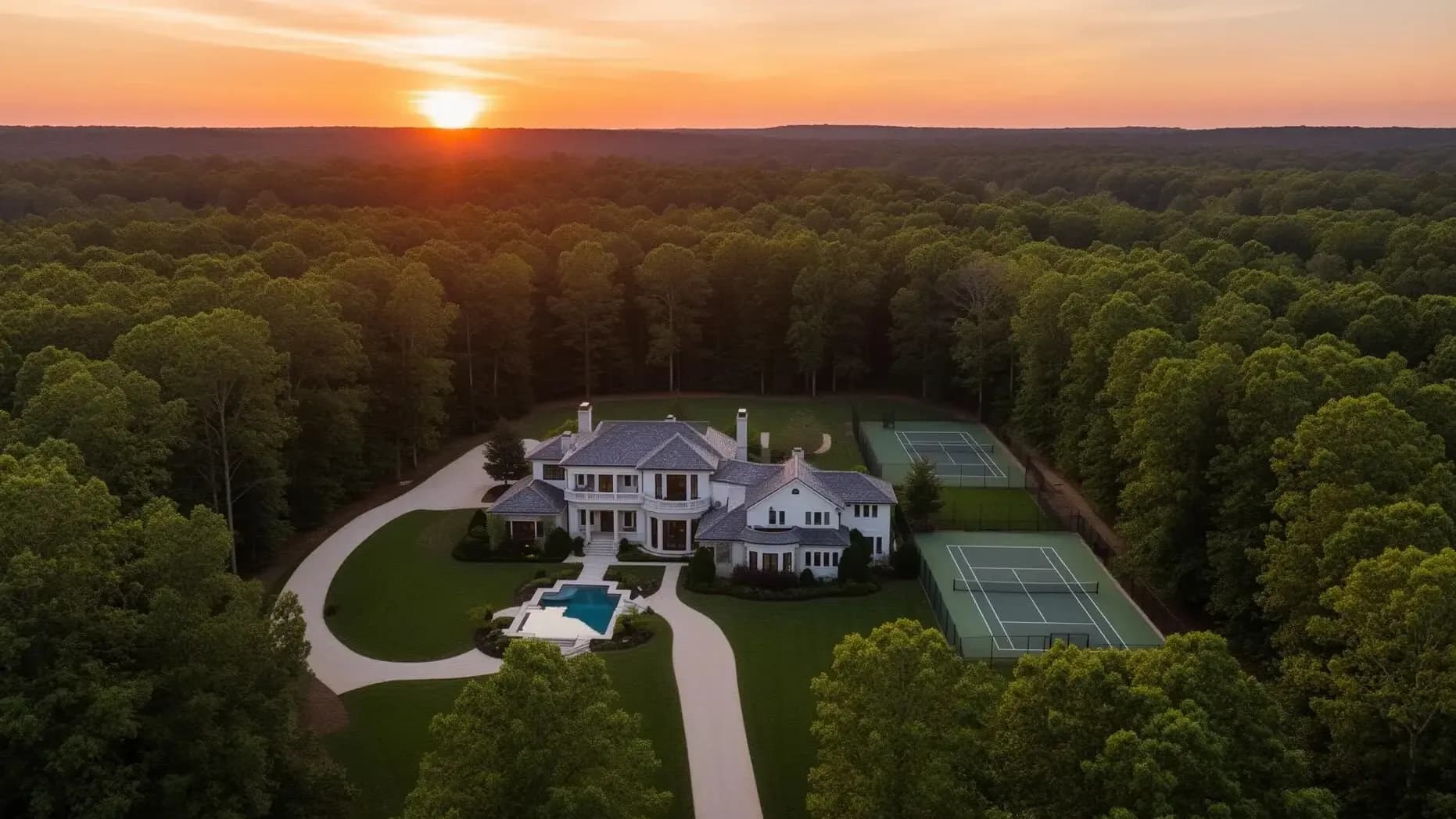
A growing share of luxury buyers want a single property that more than one household can share. The reasons vary, but the property need is consistent: separate quarters, accessible living spaces, and enough privacy that two or three generations can live close while keeping their own day-to-day rhythm. In Atlanta, that need points toward a specific kind of property, the multigenerational estate compound.
These are not ordinary homes with an extra bedroom. They are estates designed, or capable of being adapted, so that a guest house, an in-law suite, a finished lower level, or even an adjoining lot creates real separation within a single property. The best of them feel less like one large house and more like a small, private campus, where shared spaces and independent quarters coexist.
This guide focuses on the property itself: the features that make an estate work for multiple households, where larger lots and guest quarters tend to be found in metro Atlanta, and the design, privacy, and local zoning considerations to confirm before you buy. Throughout, the emphasis is on what the property offers and how it is built. Treat market observations as general context rather than promises, and verify local rules for any specific home.
What Makes an Estate Work for Multiple Households
The features that turn a large home into a true multigenerational estate are about separation and accessibility within one property. A detached guest house or casita gives a fully independent structure, often with its own kitchen, bath, and entrance. An attached in-law or au pair suite offers similar independence on a smaller footprint, typically with a private entrance and a kitchenette. A finished lower level can do the same when it includes a bedroom, full bath, and a separate way in and out.
Accessibility is the other half of the equation. A primary suite on the main level allows single-floor living, with a bedroom, full bath, and main living areas reachable without stairs. Step-free entries, wider doorways, and a thoughtful first-floor layout all add flexibility that benefits households at many stages. None of these features is about a particular person; they describe how usable and adaptable the property is over time.
Finally, the property has to support more than one routine at once. Dual kitchens or a second kitchenette let different households cook and gather on their own schedules. Separate HVAC zones, sound separation between living areas, and private outdoor spaces complete the picture. When these elements come together, a single estate can hold two or three households comfortably, which is the entire point of the property type.
The Building Blocks of a Shared Estate
- Detached guest house or casita: A separate structure with its own kitchen, bath, and entrance, ideal for fully independent quarters within the property.
- Attached in-law or au pair suite: A private wing or suite, often with its own entrance and kitchenette, that adds independence without a second building.
- Primary suite on the main level: Single-floor accessibility with a bedroom, full bath, and living areas reachable without stairs.
- Dual kitchens or a kitchenette: A second cooking space so more than one household can keep its own schedule.
- Adjoining lots or assembled parcels: Extra land that can host a second structure or simply preserve privacy and green space between buildings.
- Privacy zoning within the property: Sound separation, separate HVAC controls, and landscaping that screen sightlines between living zones.
Where Larger Lots and Guest Quarters Are Found in Atlanta
The estates capable of holding multiple households tend to appear where lots are larger and homes are sizable enough to include separate quarters. In the city, established Buckhead estate streets fit that description. Enclaves such as Tuxedo Park are known for substantial lots, mature landscaping, and homes large enough to support a detached guest house, a carriage house, or a finished lower level with independent living space. The broader Buckhead market includes a range of estate properties where separate quarters are more common than in denser areas.
Farther north, acreage opens up more options. Areas like Milton are known for larger parcels, where the additional land can more readily accommodate a detached guest house, a barn or carriage house conversion, or a second structure, subject to local rules. On acreage, the constraint is less often square footage and more often what the jurisdiction permits, which is why feasibility should be confirmed early.
Because true multi-structure luxury properties are limited in supply, the most reliable approach is to search by feature rather than by neighborhood alone. A property with a permitted guest house and a main-level primary suite may turn up across several areas, and casting a wider net by feature gives you more genuine options. Our team can help you target the right inventory through our home buying services.
Design and Privacy: How a Single Property Holds Several Households
Square footage alone does not make an estate work for more than one household. The design does. The most successful compounds use distance, separation, and layout to give each living zone its own sense of place, so the property feels private even though it is shared.
Physical separation. A detached guest house placed across a courtyard or garden from the main home creates immediate independence. Where a separate structure is not present, an attached suite with its own entrance and a buffer of hallways or a different wing can accomplish much of the same. Grade changes, landscaping, and the placement of windows all shape how private a space actually feels.
Sound and systems. Sound transfer is one of the most overlooked factors. Insulated walls between living zones, solid-core doors, and separate HVAC controls let households keep different schedules without disturbing one another. When touring, listen for sound carrying between spaces, because a floor plan rarely reveals how quiet a wall really is.
Shared and private outdoor space. The best compounds balance gathering areas with private retreats. A shared terrace or lawn for the whole family, paired with a small private patio or garden for a guest house, gives everyone both connection and solitude. Walk the outdoor flow in person to confirm the separation matches what the listing suggests.
Zoning and ADU Considerations to Confirm
- Rules vary by jurisdiction: The City of Atlanta, Sandy Springs, Milton, and unincorporated county areas each set their own standards for accessory dwelling units and detached guest quarters. A structure permitted on one street may not be on another.
- Confirm legal status, not marketing language: A space described as a guest house may or may not qualify as a permitted, separately metered dwelling. Verify permits and classification with the local jurisdiction.
- Second kitchens and additions: A second kitchen, separate entrance, or added structure may require permits and must meet code. Unpermitted work can create issues at resale or with insurance.
- Assembling adjoining lots: Combining parcels or placing a second residence on additional land depends on zoning, setbacks, subdivision rules, and covenants. Confirm feasibility with the planning office and an attorney first.
- Taxes and financing: A detached structure or assembled second lot may affect assessed value, and financing a multi-structure property can be more involved. Consult a tax professional and an experienced lender.
Buy an Existing Compound or Build the Features You Need
Once you know the features that matter, the next question is whether to buy an estate that already has them or to buy a larger property and add them. Both paths can work, and the right one depends on inventory, timeline, and budget.
Buying an estate that already includes a permitted guest house or in-law suite gives you a known, finished feature and a faster move-in. The trade-off is supply: true multi-structure luxury properties are limited, so the search may take patience and a willingness to act when the right home appears. Buying a larger lot and adding a guest house, converting a lower level, or assembling adjoining parcels gives you more control over the design, but it requires confirming that the local jurisdiction allows the structure, navigating permits, and managing a build or renovation.
Many buyers run both tracks at once. They search for existing properties that already meet the need while keeping a build or conversion as a backup if the right finished estate does not surface. For the local detail on what guest houses and accessory dwelling units involve in this market, see our guide on Atlanta luxury homes with guest houses and ADUs. Whichever path fits, confirming the legal and design details before you commit keeps the property flexible for years.
What to Verify Before You Buy
- Legal status of any second structure. Confirm permits and whether a guest house or suite qualifies as a separate, permitted dwelling.
- Zoning and covenants. Verify what the jurisdiction and any HOA allow for additions, second kitchens, and separate use.
- Accessibility features. Check for a main-level primary suite, step-free entries, and a layout that stays usable over time.
- Real privacy and separation. Visit in person to test sound transfer and confirm the living zones feel as separate as the plan suggests.
- Taxes and financing. Understand how a multi-structure property is assessed and financed before assuming the numbers.
Frequently Asked Questions
What features make an estate work for multigenerational living?
The features that matter most are the ones that create separation and accessibility within a single property. Look for a detached guest house, casita, or accessory dwelling unit; an attached in-law or au pair suite with its own entrance; a primary suite on the main level for single-floor accessibility; and ideally a second kitchen or kitchenette so more than one household can cook and gather independently. Sound separation between living zones, separate HVAC controls, and private outdoor areas also help. The goal is a property where two or three households can share the land while keeping day-to-day privacy. These are property features that describe how the home is built and used.
What is the difference between a guest house, a casita, an in-law suite, and an ADU?
These terms overlap and are often used loosely, so it helps to confirm what a specific listing actually offers. A guest house or casita is generally a detached structure separate from the main home. An in-law suite or au pair suite is typically attached to the main house, often with a private entrance, bedroom, bath, and sometimes a small kitchenette. An accessory dwelling unit, or ADU, is a defined legal term that varies by jurisdiction and may carry specific size, permitting, and occupancy rules. A space marketed as a guest house may or may not qualify as a permitted, separately metered dwelling. Before you rely on a structure for independent living, verify its legal status with the local jurisdiction.
Where in metro Atlanta can I find estates with guest houses or larger lots?
Larger lots and guest quarters tend to cluster where parcel sizes are bigger and zoning allows more building area. In the city, established Buckhead estate streets and enclaves such as Tuxedo Park are known for sizable lots, mature landscaping, and homes large enough to include separate quarters or finished lower levels. Farther north, areas like Milton offer acreage, where larger parcels can more easily accommodate a detached guest house, a barn or carriage house conversion, or even a second structure subject to local rules. Availability shifts with the market, so the practical step is to search for the specific features you need rather than a neighborhood name alone.
Can I buy two adjoining lots and combine them into a family compound?
Sometimes, but it depends on local zoning, subdivision rules, and whether the lots are actually available together. Buyers occasionally assemble adjoining parcels to create a larger compound, place a second residence on one lot, or simply preserve privacy and green space between structures. Whether you can build a second dwelling, combine lots into one parcel, or keep them separate depends on the jurisdiction, the zoning district, setbacks, and any covenants. Assembling parcels is a more complex transaction than buying a single home, so it is worth confirming feasibility with the local planning office and an attorney before you commit.
Are ADUs and guest houses allowed everywhere in Atlanta?
No. Rules for accessory dwelling units and detached guest quarters vary by jurisdiction within metro Atlanta and can differ by zoning district even within a single city. The City of Atlanta has updated its accessory dwelling unit rules over time, and surrounding jurisdictions like Sandy Springs, Milton, and unincorporated county areas each have their own standards for size, height, setbacks, occupancy, and whether a unit can be rented separately. A structure that is permitted on one street may not be on another. Always verify current local rules for the specific property before you assume a guest house can be added or used a certain way. For a deeper look at how this works locally, see our guide on Atlanta luxury homes with guest houses and ADUs.
Why does a primary suite on the main level matter for a shared family estate?
A primary suite on the main level is an accessibility feature that benefits households at many stages. Single-floor living means a bedroom, full bath, and main living areas are reachable without stairs, which can matter for members of a household who prefer or need to avoid stairs. In a multigenerational estate, a main-level suite paired with additional bedrooms upstairs or in a separate wing gives households flexible options for how to arrange the space. It is a design and accessibility consideration about the property, and many luxury buyers value the single-floor option for its long-term flexibility.
How do dual kitchens or a second kitchenette help in a multigenerational estate?
A second kitchen or kitchenette gives more than one household the ability to prepare meals, store food, and keep different schedules without crowding a single space. In practice, this often appears as a full kitchen in a detached guest house, a kitchenette in an attached in-law suite, or a finished lower level with its own cooking area. It supports independence and privacy while still allowing the family to gather in shared spaces when they choose. As with any added feature, confirm that a second kitchen was permitted and built to code, since unpermitted kitchens can create issues at resale or with insurance.
How can a single property provide privacy for more than one household?
Privacy on a shared estate comes from how the property is laid out rather than from its size alone. Detached structures, separate entrances, sound-insulated walls between living zones, independent HVAC controls, and thoughtful landscaping all create distance within the same parcel. A well-designed compound might place a guest house across a courtyard or garden from the main home, give each structure its own outdoor space, and use plantings or grade changes to screen sightlines. When you tour a property, walk the separation in person and listen for sound transfer, because floor plans do not always reveal how private the spaces actually feel.
Do detached guest houses and second structures affect property taxes or financing?
They can. A detached guest house, finished accessory structure, or assembled second lot may affect a property's assessed value, and financing a property with multiple dwellings can be more involved than a standard single-family loan. Lenders may treat a property differently depending on whether a second structure is a permitted dwelling, how it is classified, and whether any portion could be rented. This is not tax or lending advice, and the specifics depend on the property and your situation. Talk with a qualified tax professional and a lender experienced in luxury and multi-structure properties before you assume how a compound will be assessed or financed.
Is it better to buy an existing estate with guest quarters or build them?
Both paths can work, and the right one depends on inventory, timeline, and budget. Buying an existing estate that already includes a permitted guest house or in-law suite gives you a known, finished feature and a faster move-in, though true multi-structure luxury properties are limited in supply. Buying a larger lot and adding a guest house or converting a lower level gives you control over the design, but it requires confirming that the local jurisdiction allows the structure, navigating permits, and managing a build. Many buyers start by searching for existing options and treat building as a backup if the right finished property is not available.
What should I confirm before buying a property for multigenerational use?
Confirm the legal status of any guest house or second structure, including permits and whether it qualifies as a separate dwelling. Verify zoning and any covenants that govern additions, second kitchens, or separate rentals. Check accessibility features you care about, such as a main-level suite or step-free entries. Review how separate the living zones really are by visiting in person. Confirm how the property is assessed and how it can be financed. Finally, think through long-term flexibility, since a well-designed compound should adapt as a family's needs change. Working with an agent who knows luxury and multi-structure properties helps you vet these details before you commit.
Searching for an Estate the Whole Family Can Share?
Guest houses, in-law suites, adjoining lots, and main-level suites are specific features to search for, and the right inventory is limited. Our team can help you target Atlanta estates that fit your needs and confirm the legal and design details before you buy.
Talk to a Local Agent
Sources
- City of Atlanta Zoning and Accessory Dwelling Unit rules, AtlantaGA.gov. Standards for accessory dwelling units, accessory structures, and permitting within the City of Atlanta, which have been updated over time and vary by zoning district.
- Local jurisdiction planning offices, City of Sandy Springs, City of Milton, and applicable county planning and zoning departments. Standards for guest houses, second structures, setbacks, and occupancy vary by jurisdiction across metro Atlanta.
- National Association of Realtors, NAR.realtor. General buyer-trend research, including interest in homes that can accommodate more than one household. Treat any share figures as general, time-bound observations to verify against the current report.
Neighborhood characteristics, lot sizes, and the availability of guest quarters vary by property and over time. Zoning and accessory dwelling rules are subject to change and differ by jurisdiction. This article is for informational purposes only.
Disclaimer: This article is for informational purposes only and does not constitute legal, financial, tax, or zoning advice. It describes property features such as guest houses, in-law suites, adjoining lots, and accessible design, and is not intended to indicate any preference based on, or to steer any person toward or away from a property because of, race, color, religion, sex, handicap, familial status, national origin, or any other class protected by fair housing law. Zoning rules, accessory dwelling regulations, permitting, tax treatment, and financing depend on the specific property and jurisdiction and may change. Always verify current local zoning and accessory dwelling requirements, confirm the legal status of any second structure, and consult a qualified tax professional, a lender, and a Georgia real estate attorney before buying. The Luxury Realtor Group is a real estate brokerage and does not provide legal, tax, or zoning advisory services. We are committed to equal housing opportunity and comply with the Fair Housing Act. Equal Housing Opportunity.