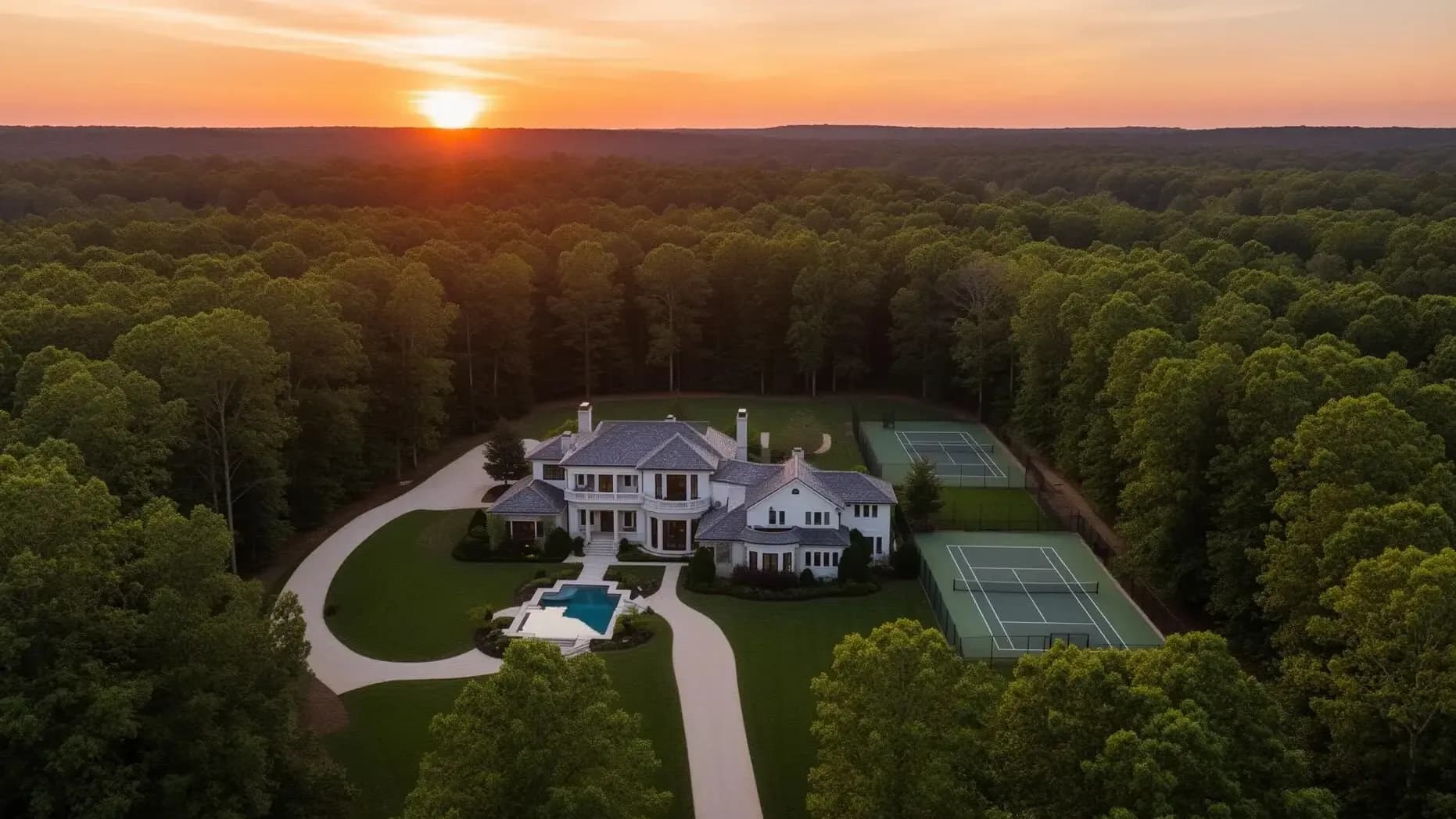
The acre you think you are buying and the acre you can actually use are frequently not the same acre. On a quarter-acre lot in a platted subdivision that difference rarely amounts to much. On five acres in Milton, it can be the whole reason you wanted the property.
Buyers at this level order a home inspection almost reflexively, and they should. But an inspection examines the structure. It does not tell you where your boundary actually runs, who else has the right to cross your land, whether the pool site sits inside a drainage easement, or who is responsible when the private road washes out.
Those questions are answered by a survey and by a careful read of what is recorded against the property, and they are worth answering before your due-diligence period expires rather than during your first winter. This guide covers what to look for on an estate lot in Alpharetta, Milton, Sandy Springs and anywhere else the parcels get large enough for the ground to have its own history.
The Short Answer
An inspection and a survey answer different questions. One examines the house. The other establishes what you own and what others may do on it.
Easements restrict the usable acre, not the owned acre. You keep title. What you may build on it is another matter.
Private roads come with obligations. Ask whether a recorded maintenance agreement exists before you assume the county plows it.
Order the survey early. Surveyors keep their own calendar, and a result that lands after your due-diligence period is not a result.
General guidance only. Every parcel differs. Consult a Georgia real estate attorney about your specific property.
What a Survey Shows That Nothing Else Does
A survey locates the boundary on the ground and shows what sits in relation to it. On a large parcel that regularly produces information no other part of the transaction would have surfaced:
- Where the line actually runs. Not where the fence is, not where the treeline is, not where the previous owner believed it was.
- Encroachments in both directions. A neighbor's structure over your line, or yours over theirs. Both are worth knowing before you own the problem.
- Easement locations. Recorded rights, drawn where they physically fall rather than described in legal language.
- Setbacks and buildable area. The envelope you actually have to work within, which on a wooded or irregular parcel is often smaller than it looks.
- Access. How the property is legally reached, which matters enormously when the driveway crosses land you do not own.
Mature landscaping hides a great deal. A hedge planted forty years ago, a gravel drive that has moved twice, a retaining wall built by an owner three transactions ago: none of these necessarily sit where the plat says they should, and none of them announce themselves during a walkthrough.
Easements: You Own It, You Just Cannot Use It
An easement gives someone else the right to use part of your land for a defined purpose. You keep ownership. What changes is what you may do with that strip, and often who may enter it without asking.
The common varieties on estate property are utility easements, which let a provider reach and maintain their lines; drainage easements, which accommodate the movement of water and are frequently the ones people discover late; and access easements, which let a neighbor cross to reach their own parcel.
The practical consequence is almost always the same conversation. A buyer has a plan for the property, and the plan involves a specific piece of ground. A pool, a guest house, a barn, a sport court, a long addition off the back. The plan is priced into the offer. Then the survey arrives and the intended location sits inside an easement, and the plan needs somewhere else to go, or needs to shrink, or does not work.
Overlay the plan on the survey, not on the listing photos
If the property is being bought partly for what you intend to add to it, the useful exercise is to put your intended footprint on the survey and see whether it fits inside the buildable area once easements, setbacks and any septic field are accounted for. That is a short conversation with the right drawing in front of you and an expensive discovery without it. It also belongs alongside accessory dwelling rules if a guest house is part of the plan.
Private Roads and Shared Drives
Plenty of desirable estate property in north metro Atlanta is reached by a road the county does not maintain. That is often part of the appeal: a private drive, a gate, no through traffic. It also transfers a set of obligations to the owners who use it.
The questions worth answering before closing are straightforward, and the answers vary wildly from property to property. Is there a recorded maintenance agreement, and may I read it? How are costs shared, and how are decisions made when owners disagree? What has actually been spent on the road in recent years? Who holds the obligation if a neighbor stops paying? And is the legal access to this property recorded, or is it something everyone has simply done for years?
That last one is worth dwelling on. Long-standing practice and recorded right are not the same thing, and the distinction tends to surface at the least convenient moment: when a neighboring parcel changes hands and the new owner has a different view of what the driveway is for. Lenders can also take an interest in private road access and in whether a maintenance agreement is recorded, so this can reach your financing as well as your neighbors.
Sequencing It Properly
Most of what goes wrong here is a timing problem rather than a knowledge problem. Buyers know a survey exists. They order it late, it arrives near the end of the due-diligence period, and there is no room left to act on what it says.
- Ask what already exists. Any prior survey, plat, recorded easements, road agreement. Free, immediate, and sometimes sufficient to reframe the question.
- Commission the survey early. Surveyors schedule on their own availability, and weather affects fieldwork. This is a first-week task.
- Have the title work and the survey read together. Recorded but invisible, or visible but unrecorded, is where the trouble sits, and a Georgia real estate attorney is the right person to read the gap.
- Overlay your actual plans. Not a general sense of the lot. The specific footprint you intend to build.
- Decide with time left. If the answer changes the value of the property to you, you want room to renegotiate or walk rather than a deadline in two days.
None of this is a reason to avoid estate property. Large lots are bought for space, privacy and the ability to do things a subdivision will not allow, and most of them deliver exactly that. The point is that the ground has a history, that history is recorded, and reading it is cheap compared to what it costs to find out afterwards. Our luxury due-diligence checklist covers the rest of the sequence, and because Georgia follows caveat emptor it is worth knowing what a seller must tell you and what they need not before you rely on anything you were told.
Frequently Asked Questions
Do I need a survey when buying a home in Georgia?
A survey is not universally required to close, and on a tract in a platted subdivision many buyers skip it. On an estate lot it is a different calculation. Larger parcels are where boundary questions, easements, encroachments and access issues actually live, and none of those appear in a listing or a home inspection. A home inspector examines the structure. A survey examines what you own and what others are entitled to do on it. Those are different questions and only one of them is answered by the inspection most buyers order automatically.
What is an easement and how does it affect what I can build?
An easement is a right held by someone else to use part of your property for a defined purpose. Utility easements allow a provider to access and maintain lines. Drainage easements accommodate water movement. Access easements allow a neighbor to cross your land to reach theirs. You still own the ground, but your ability to build on it, plant across it, fence it or pave it may be restricted, and the holder generally has the right to enter and to clear what obstructs them. On a large lot this matters most when the area you had earmarked for a pool, a guest house or an addition turns out to sit inside one.
What is a private road maintenance agreement?
Where a road is not publicly maintained, the owners who use it are generally responsible for its upkeep, and the terms of that responsibility should be set out in a written agreement recorded against the properties. It typically addresses who pays what share, how decisions are made, and what happens when a party does not pay. Where no agreement exists, or where it exists but is vague, maintenance becomes a negotiation with neighbors every time the road needs work. Some lenders also look closely at private road access and at whether a recorded agreement is in place, so this can affect financing as well as your future weekends.
What is an encroachment and how serious is it?
An encroachment is something physically crossing a boundary line: a fence set a few feet onto the neighbor's side, a driveway that clips the corner of the adjoining parcel, a shed or a retaining wall built over the line. Severity varies enormously. Some are trivial and resolved with a recorded agreement. Others cloud title, complicate a future sale, or require something to be moved at real expense. The important point is that encroachments are frequently invisible from the ground. Mature landscaping, long-standing fences and gravel drives can all sit in places the plat does not put them, and only a survey will tell you.
Will the title search catch easements and boundary problems?
A title examination and a survey answer overlapping but different questions. Title work reveals what is recorded in the public record, which generally includes recorded easements and matters affecting title. A survey shows what physically exists on the ground and how it relates to the boundary. Something can be recorded and not visible, or visible and not recorded, and it is the gap between those two that causes the most trouble. Discuss with a Georgia real estate attorney how the two fit together for your specific property and what your title policy will and will not cover.
When should I order a survey relative to my due diligence period?
Early, because surveyors work on their own schedule rather than yours. A survey ordered late in a due-diligence period can arrive after the period expires, which means either an extension you have to negotiate or a decision made without the information. If your plans for a property depend on where you can build, treat the survey as one of the first things you commission rather than one of the last, and give yourself time to act on what it shows.
Does a septic system change how much of the lot I can use?
It can, significantly. Where a property is served by a septic system rather than public sewer, the drain field and any required replacement area occupy land that cannot generally be built on, paved or planted over. On a large parcel this is often invisible until you overlay it on a site plan and discover it sits where you intended to put the pool. Our guide to septic and sewer considerations covers the topic in more depth, and it belongs on the same due-diligence list as the survey.
Can I rely on the seller's old survey?
Sometimes, and it is worth asking for whatever exists because it is useful context and may save time. But an older survey reflects conditions as of its date. Fences move, structures get added, neighbors build, easements get granted. The older the document, the more has potentially changed since. Discuss with your attorney whether an existing survey is adequate for your purposes or whether the property and your plans warrant a current one.
Disclaimer: This article is general information, not legal advice. Survey requirements, easement rights, access law and private road obligations are fact-specific and vary by property and jurisdiction. Consult a licensed Georgia real estate attorney and a licensed Georgia surveyor about any specific parcel before relying on any of this for a purchase decision. No particular outcome is guaranteed.