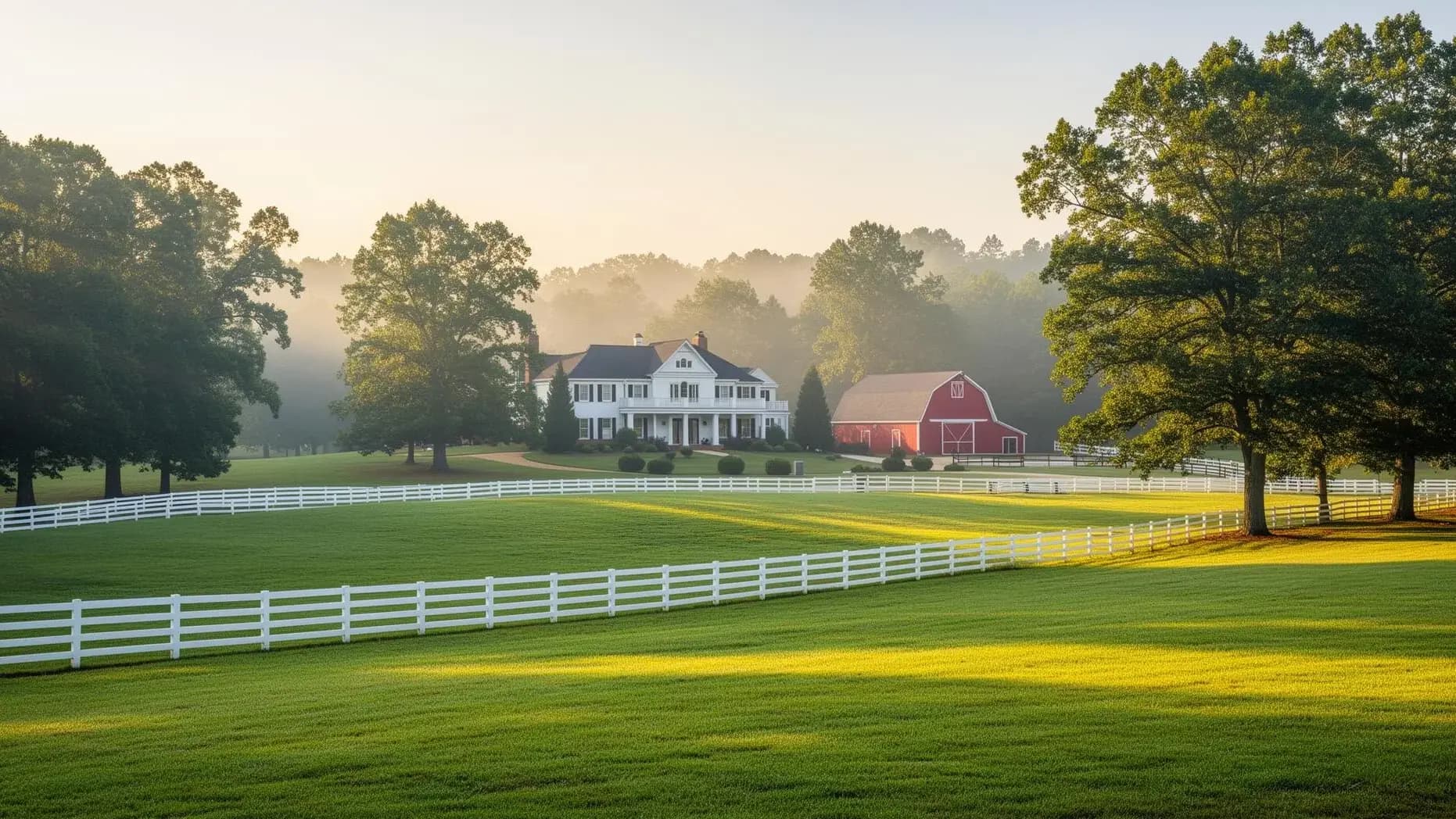
Milton occupies a unique position in metro Atlanta's luxury real estate market. Located about 30 miles north of downtown along the GA-400 corridor, this city of approximately 40,000 residents has deliberately preserved its rural, agricultural, and equestrian character even as the suburbs grew up around it. While neighboring Alpharetta built tech campuses and mixed-use developments, Milton protected its large lots, horse farms, and open spaces through strict zoning and a city government that genuinely values the land.
The result is something rare in metro Atlanta: a community where you can own 5 to 15 acres of rolling pasture, keep horses, and still be within 15 minutes of Alpharetta's restaurants and employment centers. Milton's public schools (served by Fulton County Schools) rank among the best in Georgia. The Crabapple crossroads area provides a genuine town center with shops, dining, and community events. And the luxury housing stock ranges from custom estates on multi-acre lots to newer homes in conservation subdivisions that balance development with green space preservation.
This guide covers everything a luxury buyer needs to know about Milton: the neighborhoods, the equestrian culture, the schools, the tax considerations, and the market dynamics that make this community worth serious consideration.
Equestrian Properties: Milton's Defining Feature
Milton is the premier equestrian community in metro Atlanta. The city's zoning specifically protects the right to keep horses and other livestock on residential properties, and the community has an active, established equestrian culture that includes boarding facilities, riding academies, competitive show barns, and a network of trails and back roads suitable for riding.
Equestrian properties in Milton range from modest setups (a 3-acre lot with a small barn and a couple of paddocks) to full competition-level facilities with covered arenas, multiple barns, tack rooms, wash stations, hay storage, and 10 to 20+ acres of fenced pasture. The most sought-after equestrian properties have gently rolling terrain with good drainage (critical in Georgia's clay soil), mature hardwood canopy for shade, a reliable water source, and road frontage for trailer access.
According to FMLS data, equestrian properties in Milton with 5+ acres and proper horse infrastructure typically sell for $1.5 million to $5 million, with exceptional estates (10+ acres, competition-grade facilities, luxury homes) reaching $7 million to $10 million+. The equestrian component adds significant value: a comparable home on a comparable lot without horse infrastructure typically sells for 15% to 25% less than a fully equipped equestrian property. You can browse current estate inventory on our Milton homes $3M to $5M and Milton homes $5M+ pages.
For buyers who do not own horses but appreciate the aesthetic and privacy that large equestrian-zoned lots provide, Milton still offers tremendous value. The open space, the views, and the assurance that your neighbor cannot subdivide their property into townhomes create a living environment that is increasingly rare this close to a major city.
Estate Lots: Space That Simply Does Not Exist Closer to the City
Milton's minimum lot sizes are among the largest in metro Atlanta. Depending on the zoning district, minimum lots range from 1 acre to 3+ acres for residential development. Many existing properties are significantly larger, with 5 to 15-acre parcels common in the western and northern parts of the city. This stands in sharp contrast to Buckhead (where a half-acre is considered generous), Sandy Springs (quarter-acre to half-acre typical), or Alpharetta (quarter-acre to one-acre in most subdivisions).
The large lot sizes are by design. Milton incorporated as a city in 2006 specifically to prevent high-density development that was being planned for the area under unincorporated Fulton County zoning. The city's comprehensive plan emphasizes rural character preservation, and the zoning code reflects this with large-lot minimums, setback requirements, and limitations on commercial development.
For luxury buyers, this means Milton offers something you genuinely cannot find closer to the city: acreage. Room for a pool, a tennis court, a detached garage, a guest house, extensive gardens, and still have buffer space between you and your neighbors. The privacy is real, and it is protected by zoning that is unlikely to change given the city's founding purpose. Buyers who would rather have the pool, courts, and clubhouse managed by a community will find nearby options in our guide to gated communities in North Atlanta with clubhouse and sports amenities.
The Crabapple Crossroads: Milton's Town Center
Crabapple is the historic heart of Milton, centered around the intersection of Crabapple Road, Birmingham Highway (SR 372), and Mayfield Road. What was once a quiet country crossroads has evolved into a charming town center with independently owned restaurants, a farmers market, boutique shops, and community gathering spaces. The development has been intentional: Milton's city government has worked to create a walkable village center without compromising the surrounding rural character.
The Crabapple Market, held on Saturdays from April through November, draws visitors from across North Fulton with local produce, artisan goods, and prepared foods. Restaurants like the Crabapple Tavern and other local spots provide dining options without requiring a drive to Alpharetta or Roswell. A new mixed-use development at the crossroads is adding additional retail, restaurant, and office space while maintaining the small-scale, village-appropriate design standards the city requires.
For real estate, proximity to Crabapple matters. Homes within a 5 to 10-minute drive of the crossroads benefit from the convenience of the town center while maintaining the large-lot, rural feel that defines Milton. Properties within walking distance of Crabapple (a small and growing category) carry premiums of 5% to 10% over comparable homes farther out.
Schools: Among the Best in Georgia
Milton is served by Fulton County Schools, and the schools serving Milton neighborhoods are consistently among the highest-rated in the state. This is a significant driver of luxury home demand, as school quality weighs heavily in Milton purchase decisions.
Key Schools Serving Milton
- Cambridge High School: Rated 9/10 on GreatSchools. Nationally recognized STEM programs. Strong AP offerings and competitive athletics. Serves eastern Milton.
- Milton High School: Rated 8/10 on GreatSchools. Known for strong athletics (particularly football and baseball), broad AP curriculum, and active extracurricular programs. Serves western Milton.
- Cogburn Woods Elementary: Rated 9/10 on GreatSchools. Consistently one of the top-performing elementary schools in Fulton County.
- Birmingham Falls Elementary: Rated 8/10. Strong community involvement and STEM enrichment programs.
- Northwestern Middle School: Rated 8/10. Feeds into Cambridge and Milton high schools.
Private school options nearby include King's Ridge Christian School (PreK-12, located in Alpharetta), Mount Pisgah Christian School, and several Montessori programs. Ratings per GreatSchools.org, 2025-2026 academic year.
Estate and Equestrian Acreage in Milton
The Milton acreage market is small, and the right parcel typically does not sit long. We can walk you through what is active now, what is under contract, and what fits your acreage, barn, and pasture requirements.
See What Is Available in Miltonor call (770) 727-4052
Conservation Subdivisions and Agricultural Exemptions
Two features of Milton's land use framework are particularly relevant for luxury buyers: conservation subdivisions and agricultural tax exemptions.
Conservation subdivisions are Milton's approach to allowing residential development while preserving open space. In a traditional subdivision, every square foot of land is divided into individual lots. In a conservation subdivision, homes are clustered on smaller lots (typically half-acre to one acre) while 40% or more of the total acreage is permanently preserved as open space. This open space typically includes meadows, woodlands, stream corridors, and trail systems that residents can enjoy but that will never be developed.
The practical result is a neighborhood that feels more like a country estate than a subdivision. You might have a half-acre lot, but your backyard opens onto 30 acres of preserved woodland. Several of Milton's most desirable luxury communities follow this model, and homes in conservation subdivisions have shown strong appreciation because the permanently preserved land creates amenity value that increases over time.
Agricultural exemptions offer significant tax savings for qualifying properties. Georgia's Conservation Use Valuation Assessment (CUVA) program allows land actively used for agricultural purposes to be assessed at its agricultural value rather than fair market value. For a 15-acre Milton estate with an assessed fair market value of $1.5 million, the property taxes at full valuation might be $50,000 to $55,000 per year. Under CUVA, the agricultural portion of the land could be assessed at a fraction of that value, potentially reducing the total tax bill to $15,000 to $25,000. The requirement is a minimum of 10 contiguous acres in bona fide agricultural use, with a 10-year covenant commitment.
For equestrian property owners, qualifying for CUVA is often straightforward: hay production, horse breeding, or boarding operations can qualify as agricultural use. Consult with the Fulton County Tax Assessor and a tax professional to understand the specific requirements and commitments involved.
Milton Luxury Price Ranges by Property Type (2025-2026)
Based on FMLS closed sale data. Prices vary by lot size, home size, condition, and specific location.
- Equestrian estates (5+ acres, horse infrastructure): $1.5 million to $10 million+. Price driven by acreage, barn quality, arena, and home size.
- Large-lot estates (2-5 acres, no horse infrastructure): $1.2 million to $4 million. Custom homes on wooded or pastoral lots.
- Conservation subdivision homes (0.5-1.5 acres): $800,000 to $2.5 million. Newer construction with community open space.
- Crabapple-area homes: $900,000 to $2 million. Proximity premium to the town center and walkable amenities.
- New construction custom homes: $250 to $500+ per square foot depending on builder, lot, and specifications.
Commute and Transportation
Milton is a car-dependent community. There is no MARTA rail service, and bus service is limited. The primary commute route is GA-400, which runs north-south through eastern Milton and provides direct access to Sandy Springs, Buckhead, Midtown, and downtown Atlanta. The GA-400 Express Lanes (Peach Pass) can reduce peak-hour commute times by 10 to 20 minutes.
For daily commuters heading to the Perimeter or Buckhead, the drive is real: 40 to 60+ minutes during peak hours. But the remote work revolution has changed the calculation for many Milton buyers. If you commute two or three days per week instead of five, the trade-off of a slightly longer drive in exchange for 5 acres, horses, and top schools starts to look very different.
Alpharetta is only 10 to 15 minutes south of most Milton locations, and the growing Alpharetta employment base (including major offices for Microsoft, LexisNexis, Verizon, and numerous tech firms) means some Milton residents have very short commutes. The Avalon mixed-use district in Alpharetta provides shopping, dining, and entertainment without needing to drive to Atlanta proper.
Why Milton Matters for Luxury Buyers
Milton offers something you cannot replicate closer to the city: genuine estate living with top schools, a protected rural character, and a community that values land and open space. The equestrian culture, the conservation-minded zoning, and the agricultural tax exemptions create an ecosystem that rewards owners who value these assets.
The trade-off is distance from Atlanta's urban core. Milton is not for the buyer who wants to walk to restaurants in Buckhead or bike the Beltline on weekday evenings. It is for the buyer who wants to look out the kitchen window at 10 acres of pasture, ride horses on their own property, and send their children to some of the best public schools in the state.
If that sounds right, our team can help. We work with buyers across North Fulton and understand the nuances of Milton's micro-markets, zoning requirements, equestrian property considerations, and agricultural exemption strategies. Let us help you find the right property in this one-of-a-kind community.
Frequently Asked Questions
How far is Milton from downtown Atlanta?
Milton is approximately 30 miles north of downtown Atlanta along GA-400. During off-peak hours, the drive takes about 35 to 45 minutes. During morning and evening rush hours, commute times can range from 55 minutes to 1.5 hours depending on your exact starting and ending points. Many Milton residents commute to Alpharetta (10 to 15 minutes), Roswell (15 to 20 minutes), or the Perimeter area (25 to 35 minutes off-peak). The rise of remote and hybrid work has made Milton increasingly attractive to professionals who only need to commute a few days per week.
What school district serves Milton?
Milton is served by Fulton County Schools, one of the highest-performing districts in Georgia. The two primary high schools serving Milton are Cambridge High School and Milton High School, both consistently ranked among the top public high schools in the state. Cambridge High School in particular has received national recognition for its STEM programs. Elementary schools serving Milton neighborhoods include Cogburn Woods, Birmingham Falls, and Crabapple Crossing. The quality of Milton's public schools is one of the top three reasons families cite for choosing the community.
Can I keep horses on my property in Milton?
Yes, and this is one of Milton's defining features. The city's zoning is specifically designed to preserve its rural and equestrian character. Most residential lots in Milton are zoned for agricultural use, which permits horses and other livestock. The city requires a minimum of one acre per horse as a general guideline, though specific requirements vary by zoning district. Milton has an active equestrian community with multiple boarding facilities, riding academies, and a network of trails and back roads suitable for horseback riding. If equestrian use is important to you, work with an agent who understands which properties have the right terrain, fencing, water access, and zoning for horses.
What is the Crabapple area of Milton?
Crabapple is a historic crossroads community in the heart of Milton that serves as the city's informal town center. The intersection of Crabapple Road, Birmingham Highway, and Mayfield Road is home to a collection of shops, restaurants, and community gathering spots including the popular Crabapple Market. The area has been thoughtfully developed to maintain a small-town feel while adding dining, retail, and community amenities. Homes near Crabapple command a walkability premium similar to what you see near Canton Street in Roswell. It is the social center of Milton and a key selling point for the community.
What are conservation subdivisions in Milton?
Conservation subdivisions are a zoning tool Milton uses to preserve open space while allowing residential development. In a conservation subdivision, homes are clustered on smaller lots while a significant portion (typically 40% or more) of the total development acreage is preserved as permanent open space, often including meadows, woodlands, streams, and trail corridors. This approach gives homeowners the benefit of community living while maintaining Milton's rural character and protecting environmentally sensitive areas. Several luxury communities in Milton follow this model, offering homes on half-acre to one-acre lots surrounded by dozens of acres of preserved green space.
How do agricultural exemptions work for Milton properties?
Georgia offers a Conservation Use Valuation Assessment (CUVA) that allows qualifying agricultural land to be assessed at its agricultural use value rather than its fair market value. This can reduce property tax bills by 50% to 80% or more on large parcels with active agricultural use (including horse farming, hay production, or timber management). To qualify, you need a minimum of 10 contiguous acres devoted to bona fide agricultural purposes. The covenant runs for 10 years and comes with penalties for early withdrawal. For Milton estate buyers with 10+ acres, the tax savings can be significant: a 15-acre property that might owe $25,000 annually at fair market assessment could pay as little as $5,000 to $8,000 under CUVA. Consult a tax professional and the Fulton County Tax Assessor's office for specific eligibility requirements.
What types of luxury homes are available in Milton?
Milton's luxury inventory is dominated by estate homes on large lots. Typical options include: custom-built estates on 2 to 10+ acre lots with 5,000 to 12,000+ square feet; equestrian properties with barns, paddocks, riding arenas, and pasture; conservation subdivision homes on half-acre to one-acre lots with community open space; and newer luxury communities with homes in the 4,000 to 7,000 square foot range. Architecture styles are predominantly Colonial Revival, Georgian, and farmhouse-modern, with some contemporary and French Provincial. Most Milton luxury homes feature generous outdoor living spaces, pools, and multi-car garages. The overall character is distinctly different from intown Atlanta: more space, more green, more privacy.
How does Milton compare to Alpharetta and Roswell for luxury real estate?
Milton, Alpharetta, and Roswell are neighboring North Fulton cities that each attract a different type of luxury buyer. Milton offers the largest lots, the most rural character, equestrian opportunities, and the strongest sense of privacy. Alpharetta offers newer construction, proximity to Avalon and the tech corridor, and more suburban amenities. Roswell offers Canton Street dining culture, Chattahoochee River access, and historic district charm. Milton buyers typically prioritize space, land, privacy, and outdoor living. Price points in Milton start higher due to larger lot sizes: the entry point for luxury is roughly $1.2 million, with estates reaching $5 million to $10 million+.
Is Milton a good long-term investment for luxury real estate?
Milton has demonstrated strong appreciation in the luxury segment. Per FMLS data, homes priced at $1 million and above in Milton have appreciated approximately 30% to 50% over the past five years. The city's strict zoning (large minimum lot sizes, limited commercial development, conservation requirements) constrains new supply, which supports property values over time. The combination of top-rated schools, equestrian culture, proximity to Alpharetta's employment corridor, and a city government committed to preserving the rural character creates a strong long-term value proposition. No investment is guaranteed, but Milton's fundamentals are among the strongest in metro Atlanta.
What should I know about well and septic systems in Milton?
Many properties in Milton (particularly those on larger lots outside of subdivisions) use private well water and septic systems rather than municipal water and sewer. This is common in the area and functions well when properly maintained, but buyers need to understand the implications. Wells should be tested for water quality (including bacteria, minerals, and pH) as part of the inspection process. Septic systems should be inspected and pumped (if needed) before closing. Septic system replacement can cost $15,000 to $40,000 depending on the system type and site conditions. The Fulton County Health Department regulates septic systems in the area. Your agent should help you understand whether a specific property uses well/septic or municipal services.
Interested in estate or equestrian living in Milton?

Sources
- FMLS (First Multiple Listing Service) - Milton luxury home and equestrian property sales data, price trends, and days-on-market statistics.
- Fulton County Schools - School ratings, attendance zone maps, and enrollment data for Milton-area schools.
- GreatSchools.org - School ratings and parent review data for Cambridge High, Milton High, and feeder schools.
- City of Milton - Comprehensive plan, zoning ordinances, conservation subdivision guidelines, and historic information.
- Fulton County Tax Assessor - CUVA (Conservation Use Valuation Assessment) program guidelines and property tax information.
- Georgia Department of Revenue - Agricultural exemption (CUVA) requirements and covenant terms.
Market data, school ratings, tax information, and price ranges referenced in this article reflect conditions as of early 2026 and are subject to change. Agricultural exemption eligibility depends on specific property characteristics and use. Past appreciation does not guarantee future performance.
Disclaimer: This article is for informational purposes only and does not constitute real estate, tax, or investment advice. Property values, tax rates, school ratings, and zoning regulations are approximate and may not reflect current conditions. Agricultural exemption eligibility requires meeting specific state and county criteria and involves a 10-year covenant with penalties for early withdrawal. The Luxury Realtor Group recommends independent verification of all information and consultation with qualified tax, legal, and real estate professionals before making purchasing decisions.