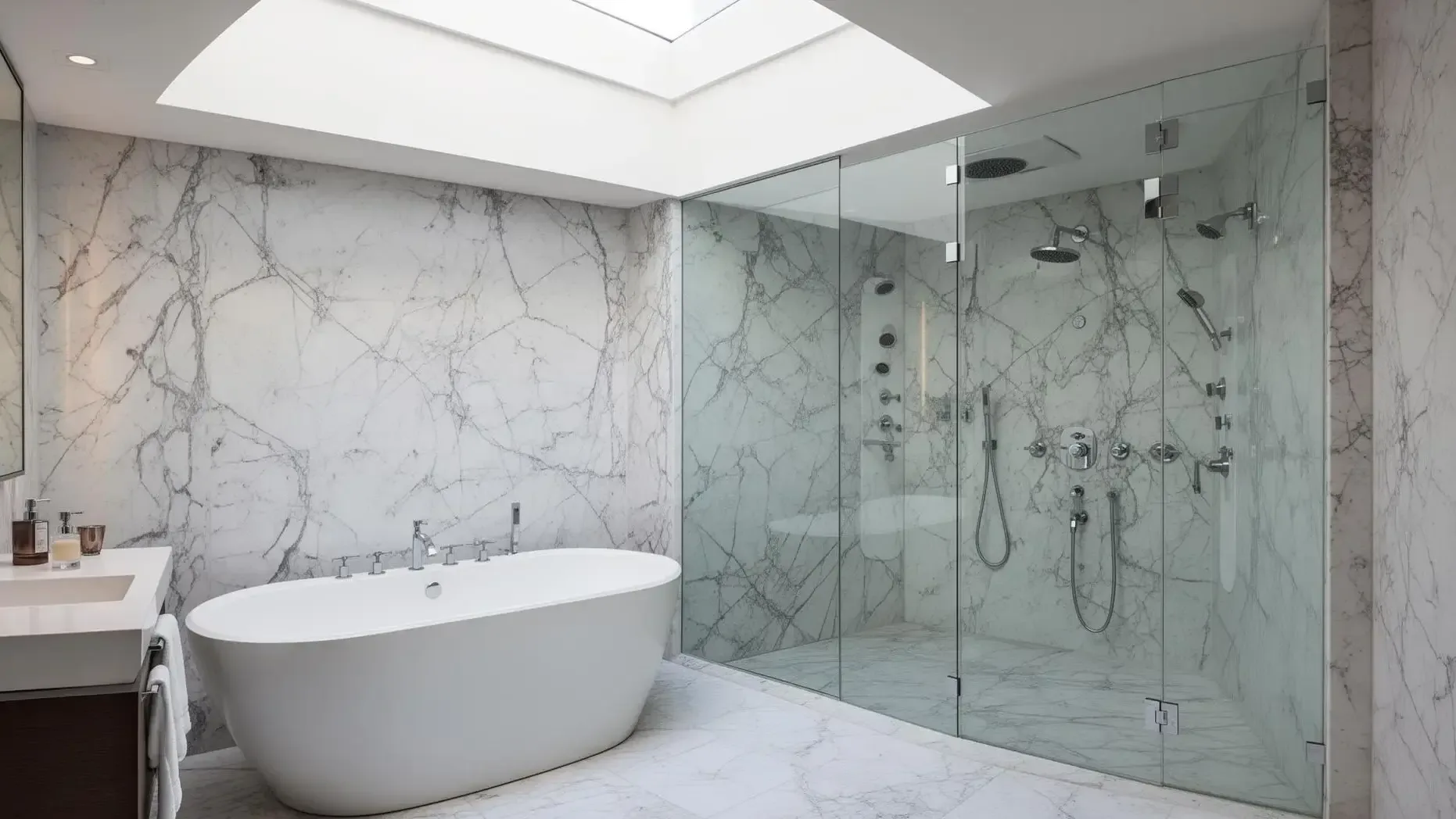
Water quality is one of those topics that rarely makes the highlight reel of a luxury home tour, but it affects daily life in ways that few other features can match. The water running through your home touches your health, your appliances, your plumbing fixtures, your stone countertops, your glass shower doors, and your morning coffee. In a luxury home with $50,000 to $150,000 invested in bathrooms alone, water quality is not a minor detail.
Atlanta's luxury market spans a range of water situations. Intown properties in Buckhead, Midtown, and Brookhaven are on treated municipal water from the City of Atlanta or DeKalb County. Homes in North Fulton, Milton, Cherokee County, and parts of Forsyth County may be on private wells. Each situation has different quality characteristics, treatment needs, and costs.
This guide covers what Atlanta luxury homeowners and buyers need to know about water quality: what is in your water, how to test it, what treatment options make sense, and how to protect the expensive finishes and appliances that define a luxury home.
Atlanta Municipal Water: What You Are Actually Getting
The City of Atlanta's water is sourced primarily from the Chattahoochee River and treated at two major facilities: the Hemphill Water Treatment Plant and the Chattahoochee Water Treatment Plant. The water meets all EPA Safe Drinking Water Act standards, and the city publishes an annual Consumer Confidence Report (CCR) detailing test results for over 90 regulated contaminants.
The primary disinfectant used is chloramine (a combination of chlorine and ammonia), which is more stable than free chlorine and produces fewer disinfection byproducts. However, chloramine has a distinct taste and odor that some people find unpleasant. It is the most common complaint about Atlanta's water and the primary reason homeowners install filtration.
Atlanta's water is naturally soft, measuring approximately 20 to 40 parts per million (1 to 2.5 grains per gallon) according to the city's published water quality data. This is good news for homeowners because soft water produces less scale buildup on fixtures and in pipes. Most homes on Atlanta municipal water do not need a water softener.
The concern areas for Atlanta municipal water are not about safety violations. They are about the gap between "legally safe" and "optimal." Trace levels of disinfection byproducts (trihalomethanes and haloacetic acids, which form when chloramine reacts with organic matter), lead from older service lines or interior plumbing, and pharmaceutical residuals that are not regulated under current EPA rules are present at low levels. None of these exceed legal limits, but some homeowners, particularly those with health concerns or young children, prefer to remove them through additional filtration.
Well Water in North Fulton and Beyond
If you are looking at luxury homes in Milton, western Roswell, parts of Alpharetta, Cherokee County, or Forsyth County, there is a reasonable chance the property is on a private well. Well water is not regulated by the EPA (private wells are the homeowner's responsibility), which means the burden of testing and treatment falls entirely on you.
The geology of North Georgia means well water quality varies significantly even between neighboring properties. The Piedmont geological province that underlies metro Atlanta consists of fractured crystalline rock, and water quality depends on the specific rock formations the well penetrates, the well depth, and surface water influences.
Common well water issues in the Atlanta metro area include elevated iron (which causes orange staining on fixtures and laundry), manganese (black staining), hydrogen sulfide (rotten egg odor), elevated hardness (100 to 300+ ppm, much harder than municipal water), and low pH (acidic water that corrodes copper pipes). Less common but more serious issues include elevated radon, arsenic, and bacteria, all of which require specific treatment.
The Georgia Environmental Protection Division recommends well water testing at least annually. For a home purchase, a thorough test panel should include bacteria (total coliform and E. coli), nitrates, pH, hardness, iron, manganese, lead, arsenic, fluoride, and volatile organic compounds. This full panel typically costs $200 to $500 through a certified laboratory.
Filtration Options for Luxury Homes
Water treatment for luxury homes is not one-size-fits-all. The right system depends on your water source, specific contaminants, home size, water usage patterns, and budget. Here is a breakdown of the most common options.
Whole-House Carbon Filtration
The foundation of most luxury home water treatment. Carbon filters remove chlorine, chloramines, sediment, volatile organic compounds, and many taste and odor compounds. Installed on the main water line entering the home, they treat every tap, shower, and appliance. Cost: $1,500 to $5,000 installed. Filter replacements every 6 to 12 months cost $100 to $300. This is the minimum recommended treatment for Atlanta municipal water.
Water Softener
Essential for well water with hardness above 7 grains per gallon (120 ppm). Water softeners use ion exchange to replace calcium and magnesium with sodium, preventing scale buildup on fixtures, in pipes, and in appliances. Cost: $2,000 to $6,000 installed. Salt costs approximately $100 to $200 per year. Not typically needed for Atlanta municipal water, but important for North Fulton well water and some suburban municipal systems.
Reverse Osmosis (Point-of-Use)
Provides the highest level of purification at specific taps (usually the kitchen sink and refrigerator). Removes up to 99% of dissolved solids, heavy metals, pharmaceuticals, and other contaminants. Cost: $500 to $1,300 installed. Filter and membrane replacement every 1 to 3 years costs $100 to $200. Recommended for drinking and cooking water, particularly for well water with elevated contaminants.
UV Disinfection
Uses ultraviolet light to kill bacteria, viruses, and other microorganisms without chemicals. Essential for well water where bacterial contamination is possible. Installed inline after sediment filtration (particles can shield bacteria from UV). Cost: $800 to $2,500 installed. Bulb replacement annually costs $50 to $150. Recommended for all well water homes as an additional safety layer.
Iron and Manganese Removal
Specialized oxidation filters (using birm, greensand, or air injection) that remove dissolved iron and manganese before they stain fixtures and laundry. Common need for North Fulton well water. Cost: $2,000 to $5,000 installed. Media replacement every 5 to 10 years. Without treatment, iron levels as low as 0.3 ppm can cause visible orange staining on white marble, porcelain, and clothing.
Test the Water Before Your Contingency Expires
Well supply, hardness, and iron content vary widely across metro Atlanta, and treatment costs follow. We can arrange testing during due diligence so the numbers are known while you can still act on them.
Order Water Testing During Due Diligenceor call (770) 727-4052
Protecting Luxury Fixtures and Finishes
In a luxury home, water touches surfaces and fixtures that can cost tens of thousands of dollars. The intersection of water quality and high-end finishes is where many homeowners first realize they have a water problem.
Natural stone. Marble, limestone, and travertine are porous and sensitive to mineral deposits and acidic water. Hard water leaves white calcium deposits that etch the stone surface over time. Acidic water (low pH) can dissolve the stone itself. A home with $100,000 in marble bathroom finishes should absolutely have water softening if the water is hard and pH correction if the water is acidic.
Glass shower enclosures. Frameless glass shower doors are one of the first casualties of hard water. Mineral deposits bond to glass at the molecular level and become increasingly difficult to remove over time. Once etched, the glass cannot be restored to its original clarity. A water softener and squeegee habit are the best prevention. Some luxury homeowners also apply ceramic coating to shower glass ($300 to $800 professional application) for additional protection.
Premium faucets and fixtures. Brands like Waterworks, Kallista, and Dornbracht produce fixtures that can cost $2,000 to $10,000 per unit. Finishes like unlacquered brass, polished nickel, and matte black are particularly sensitive to water chemistry. Chlorine can pit certain metal finishes, and hard water leaves visible deposits. Whole-house filtration and softening protects these investments.
Appliances. According to the Water Quality Research Foundation, hard water reduces the efficiency and lifespan of water heaters by up to 48% compared to soft water. Tankless water heaters, steam ovens, steam showers, and built-in espresso machines all perform better and last longer with treated water. For a luxury home with $30,000 to $80,000 in water-using appliances, treatment is an insurance policy.
Testing Protocol for Home Buyers
Water testing should be part of every luxury home purchase due diligence, whether the home is on municipal water or a private well.
For municipal water homes: Test at the kitchen tap for lead, copper, chlorine/chloramine residual, pH, hardness, and total dissolved solids. This reveals what the water looks like after it has traveled through the city's distribution system and the home's internal plumbing. Older homes (pre-1986) may have lead solder joints or lead service lines that elevate lead levels above what the city delivers. Cost: $75 to $200 through a certified lab.
For well water homes: A thorough panel is essential. Test for bacteria (total coliform, E. coli), nitrates, pH, hardness, iron, manganese, lead, arsenic, fluoride, sulfate, total dissolved solids, and volatile organic compounds at minimum. If the property is near agricultural land, add pesticides. If near old industrial sites, add heavy metals. Cost: $200 to $500. Use a Georgia-certified laboratory (the EPD maintains a list) and follow their sampling instructions precisely to get accurate results.
What to do with results: Share the lab report with a water treatment professional who can recommend the right system configuration. A good treatment company will design a system based on your actual water chemistry, not a one-size-fits-all package. Get at least two quotes and ask each company to explain why they are recommending each component.
Water Treatment Cost Summary for Atlanta Luxury Homes
- Basic municipal water treatment (whole-house carbon filter + under-sink RO): $2,500 to $6,000 installed, $200 to $400/year maintenance.
- Well water treatment (softener + carbon filter + UV + RO): $6,000 to $15,000 installed, $400 to $800/year maintenance.
- Complex well water treatment (iron removal + softener + carbon + UV + RO): $10,000 to $25,000 installed, $600 to $1,200/year maintenance.
- Water testing (municipal): $75 to $200 per test. Well water (full panel): $200 to $500 per test.
The Bottom Line
Water quality is an overlooked but important factor in luxury homeownership. In a home where the bathroom fixtures alone may cost more than a mid-range car, protecting those finishes from water damage is common sense. For homes on well water, treatment is not optional. For homes on municipal water, basic filtration at minimum improves daily living and protects your investment.
The costs are modest relative to the value of what they protect. A $5,000 to $10,000 water treatment system in a $2 million home is a 0.25% to 0.5% investment that protects hundreds of thousands of dollars in finishes, fixtures, and appliances. Test your water, treat what needs treating, and maintain your system. Your home and your health will both benefit.
Frequently Asked Questions
Is Atlanta's municipal water safe to drink?
Yes, Atlanta's municipal water consistently meets all EPA Safe Drinking Water Act standards. The City of Atlanta's Department of Watershed Management publishes an annual Water Quality Report (Consumer Confidence Report) that details testing results for over 90 contaminants. The water is sourced primarily from the Chattahoochee River and treated at the Hemphill and Chattahoochee Water Treatment Plants. While safe by federal standards, many luxury homeowners choose to install additional filtration to address taste, chlorine/chloramine residuals, and trace contaminants that are legal but undesirable at any level.
What is the hardness of Atlanta's water?
Atlanta's municipal water is relatively soft compared to many U.S. cities, typically measuring 20 to 40 parts per million (ppm) or 1 to 2.5 grains per gallon. This is classified as soft to slightly hard by Water Quality Association standards. Most Atlanta homes on municipal water do not need a water softener. However, well water in North Fulton, Cherokee, and Forsyth counties can be significantly harder (100 to 300+ ppm), which absolutely requires softening to protect plumbing fixtures, appliances, and luxury finishes like marble and natural stone.
Should I get a whole-house water filtration system?
For a luxury home, a whole-house filtration system is a worthwhile investment. At a minimum, a carbon filtration system ($1,500 to $5,000 installed) removes chlorine, chloramines, sediment, and many organic contaminants from every tap in the house. This protects fixtures, improves water taste and smell, and reduces chemical exposure during bathing and cooking. For homes with specific concerns (well water, older pipes, high sediment), more advanced systems with multi-stage filtration, UV treatment, or ion exchange may be appropriate. The system should be sized to your home's water flow rate to avoid pressure drops.
How much does a whole-house water filtration system cost?
Costs vary significantly based on system type and home size. A basic whole-house carbon filter runs $1,500 to $3,000 installed. A multi-stage system with sediment pre-filter, carbon filter, and UV disinfection costs $3,000 to $8,000. A complete system with water softening, carbon filtration, and point-of-use reverse osmosis for drinking water runs $5,000 to $15,000. For very large luxury homes (8,000+ square feet) with high flow demands, commercial-grade systems can exceed $20,000. Annual maintenance (filter replacements, salt for softeners, UV bulb replacements) typically runs $300 to $800 per year.
What is reverse osmosis and do I need it?
Reverse osmosis (RO) forces water through a semi-permeable membrane that removes up to 99% of dissolved contaminants, including lead, arsenic, fluoride, nitrates, and pharmaceutical residuals. RO systems are typically installed as point-of-use units under the kitchen sink, providing purified water for drinking and cooking. For Atlanta municipal water, RO is not necessary for safety but provides the highest level of purification for those who want it. For well water with elevated minerals or contaminants, RO may be recommended based on testing results. A quality under-sink RO system costs $300 to $800 for the unit plus $200 to $500 for installation.
How often should I test my water?
For homes on municipal water, testing every 2 to 3 years is sufficient unless you notice changes in taste, odor, or appearance. The city tests continuously and publishes results annually. For homes on well water, the Georgia Department of Natural Resources recommends testing at least annually for bacteria (coliform and E. coli), nitrates, pH, and hardness. Broader testing every 3 to 5 years should include heavy metals, volatile organic compounds, and pesticides. After any plumbing work, flooding near the well, or changes in taste or appearance, test immediately. A basic well water test costs $50 to $150. A full panel runs $200 to $500.
Does hard water damage luxury plumbing fixtures?
Yes. Hard water deposits (calcium and magnesium scale) can damage high-end fixtures over time. Scale buildup reduces flow rates in faucets and showerheads, etches glass shower enclosures, stains natural stone surfaces, and shortens the lifespan of water-using appliances like tankless water heaters, dishwashers, and steam showers. For luxury finishes like unlacquered brass, polished nickel, or natural marble, hard water damage is particularly visible and costly to repair. A water softener ($2,000 to $6,000 installed) prevents scale formation and protects your investment in high-end fixtures and finishes.
Are there well water homes in metro Atlanta's luxury market?
Yes, particularly in the northern and western suburbs. Properties in unincorporated North Fulton, Milton, parts of Roswell, Cherokee County (particularly around Ball Ground and Canton), and Forsyth County may be on private wells rather than municipal water. Well water is common on properties with 2+ acres, equestrian properties, and estate-level homes in rural or semi-rural areas. Well water quality varies significantly by location and depth. Some wells produce excellent water that requires minimal treatment. Others have elevated iron, manganese, sulfur, or hardness that requires multi-stage treatment. Always test well water thoroughly during due diligence before purchasing.
How does water quality affect steam showers and luxury appliances?
Steam showers, tankless water heaters, espresso machines, ice makers, and other premium appliances are sensitive to water quality. Scale buildup from hard water can clog steam generator elements, reduce heating efficiency in tankless units, and shorten appliance lifespans by 30% to 50% according to the Water Quality Research Foundation. Chlorine in unfiltered municipal water can degrade rubber seals and gaskets in appliances over time. For a luxury home with $50,000 or more invested in water-using appliances, a whole-house filtration and softening system is an insurance policy that pays for itself through extended equipment life.
What should I look for regarding water quality when buying a luxury home?
During due diligence on any luxury home purchase, verify whether the home is on municipal water or well water. If well water, request recent water test results or conduct your own detailed test. Inspect the existing water treatment equipment (age, condition, maintenance records). Check for signs of hard water damage on fixtures, glass, and stone surfaces. Ask about the water heater type and age, as hard water accelerates water heater failure. For homes with pools or irrigation systems, verify the water source and treatment. These findings should inform your negotiation and your budget for post-purchase improvements.
Need help evaluating water quality before your luxury home purchase?



Sources
- City of Atlanta Department of Watershed Management - Annual Water Quality Report (Consumer Confidence Report), treatment plant operations, and water quality data.
- U.S. Environmental Protection Agency (EPA) - Safe Drinking Water Act standards, contaminant maximum levels, and private well guidance.
- Georgia Environmental Protection Division (EPD) - Well water testing recommendations, certified laboratory listings, and groundwater quality data.
- Water Quality Research Foundation (WQRF) - Research on hard water effects on appliances, fixtures, and energy efficiency.
- Water Quality Association (WQA) - Water hardness classification standards and treatment technology guidelines.
- U.S. Geological Survey (USGS) - Piedmont Province geology and groundwater characteristics for the metro Atlanta region.
Water quality data, treatment costs, and product specifications referenced in this article reflect conditions as of early 2026 and are subject to change. This article does not constitute health, environmental, or construction advice. Consult certified water testing laboratories and licensed plumbing professionals for guidance on specific water quality situations.
Disclaimer: This article is for informational purposes only. Water quality varies by location, source, and plumbing system. Treatment recommendations in this article are general guidelines and should not substitute for professional water testing and system design. The Luxury Realtor Group is a real estate brokerage and does not provide water treatment, plumbing, or health services. Consult qualified water treatment professionals, licensed plumbers, and health professionals for guidance specific to your situation.