The home office has gone from a nice-to-have feature to a non-negotiable requirement for many luxury home buyers in Atlanta. According to the National Association of Realtors' 2024 buyer survey, 47% of buyers reported working from home at least part of the week, and a dedicated office was among the top five most desired home features. In the luxury segment, that number skews even higher.
But there is a significant gap between a spare bedroom with a desk and a purpose-built home office designed for serious work. The difference affects productivity, professional image on video calls, comfort during long work days, and the resale value of your home. A well-designed luxury home office addresses all of these concerns through thoughtful planning around soundproofing, lighting, technology infrastructure, ergonomics, and aesthetics.
This guide covers what it takes to design a home office that performs at the level you would expect from a luxury home, with practical specifications, cost ranges for the Atlanta market, and design considerations that affect both daily use and long-term value.
Dedicated Office vs. Flex Space: Choosing the Right Approach
The first decision is whether to create a fully dedicated office or a flex space that serves multiple functions. Each approach has trade-offs.
A dedicated office is a room used exclusively for work. It has its own door, its own lighting scheme, purpose-built storage and technology infrastructure, and ideally its own HVAC zone. The advantages are clear: total control over the environment, no compromise with other household functions, and the ability to close the door and mentally separate work from home life. For the IRS home office deduction (if applicable to your situation), exclusive use is a requirement.
A flex space combines office function with another use, such as a library, sitting room, or guest room. This approach works well for people who work from home 2 to 3 days per week and do not want to dedicate an entire room to a function that is not used daily. The compromise is that you cannot optimize the room for work without affecting its other purpose. Soundproofing, for example, is easier to justify in a dedicated office than in a room that also hosts overnight guests.
For buyers working from home 4 or more days per week, a dedicated office is strongly recommended. The productivity and quality-of-life benefits justify the dedicated square footage. For those working remotely 1 to 3 days per week, a flex space can work well if it is designed with good technology infrastructure and adequate privacy.
Soundproofing: The Most Overlooked Feature
Soundproofing is probably the single most impactful investment you can make in a home office, and it is the feature most often skipped. Without it, you are dealing with barking dogs, children playing, landscaping crews, HVAC noise, and household activity bleeding into your work calls. In a luxury home with hardwood floors and high ceilings, sound carries even more than in a typical home.
Walls: The most effective wall treatment is a combination of resilient channels (metal strips that decouple the drywall from the studs), acoustic insulation in the wall cavity (Roxul Safe'n'Sound or equivalent), and mass-loaded vinyl (MLV) behind the drywall. This assembly can achieve an STC (Sound Transmission Class) rating of 55 to 60, which blocks most normal household noise. Cost: $3 to $6 per square foot of wall surface, or roughly $3,000 to $6,000 for a typical 200 square foot office.
Door: The door is usually the weakest point for sound. Replace hollow-core doors with solid-core doors (at minimum 1 3/4 inches thick, solid wood or solid core composite). Add perimeter gaskets (such as Pemko or Zero International acoustic seals) and a drop-down door bottom seal. A properly sealed solid-core door adds 15 to 20 STC points over a standard hollow-core door. Cost: $800 to $2,500 installed, depending on the door and hardware quality.
Windows: If the office faces a busy street or outdoor activity area, consider upgrading to laminated glass or adding an interior storm window. Dual-pane laminated glass typically provides an STC rating of 34 to 38, compared to 26 to 28 for standard dual-pane. Cost: $500 to $1,500 per window.
Within the room: Even after addressing transmission from outside, sound bouncing within the office can make calls sound echoey. Add acoustic treatments: area rugs or carpet on hard floors, upholstered furniture, acoustic panels on walls (these can be covered in fabric to match your decor), and ceiling treatments if you have hard ceiling surfaces. These internal treatments reduce reverberation time and make your voice sound clearer on calls.
Buying a Home That Has to Work as an Office?
Light direction, acoustic separation, and where the office sits relative to the rest of the house decide whether it actually gets used. We screen for that.
Find a Home With the Right Officeor call (770) 727-4052
Lighting: For Productivity and Video Presence
Good lighting serves two functions in a home office: supporting your ability to work comfortably for extended periods, and making you look professional on video calls. These two requirements sometimes conflict, so the best approach is a layered lighting design that can be adjusted for different situations.
Natural light: Position your desk perpendicular to windows rather than facing them or having them behind you. Side lighting provides even illumination without glare on screens or backlighting on video calls. North-facing windows provide the most consistent natural light throughout the day. South and west-facing windows in Atlanta can create harsh direct light from mid-morning through afternoon and may need motorized shades for control.
Task lighting: A quality desk lamp (the Humanscale Infinity, BenQ ScreenBar, or equivalent) provides focused light on your work surface without creating screen glare. Position it on the opposite side of your dominant hand to minimize shadows when writing. For desk lamps, look for CRI (Color Rendering Index) of 90 or higher and adjustable color temperature (2700K to 5000K).
Ambient lighting: Recessed ceiling fixtures on dimmers provide overall room illumination. For a 200 square foot office, plan for 4 to 6 recessed fixtures with warm-to-neutral LED bulbs (3000K to 4000K). Put them on a dimmer circuit so you can adjust intensity based on time of day and activity.
Video call lighting: The ideal video setup has a key light (your primary light source) positioned at roughly 45 degrees from your face and slightly above eye level. Many luxury offices now include a dedicated LED panel or sconce on the wall behind the monitor that serves this purpose. It should be tunable (adjustable color temperature and brightness) and controlled separately from the room's other lighting.
Technology Infrastructure: Building for Reliability
A luxury home office should never drop a call, lose internet connectivity, or trip a circuit breaker. These are table-stakes requirements, but they require planning during the design phase rather than after the room is finished.
Network connectivity: Run hardwired Ethernet (Cat6a minimum, Cat8 if you are future-proofing) from your network equipment to the desk location. Wireless is convenient, but hardwired connections are faster, more reliable, and have lower latency, all of which matter for video conferencing and large file transfers. Run at least two Ethernet drops to the desk (one for your computer, one for a VoIP phone or other device) and consider a drop at the secondary seating area if you plan to use a laptop there.
Electrical: Install at least two dedicated 20-amp circuits for the office. One handles computing equipment (desktop, monitors, dock, peripherals), and the other handles lighting, HVAC, and charging. This prevents the scenario where turning on a space heater or laser printer trips the same circuit as your computer. Include a whole-room surge protector at the panel and a UPS (uninterruptible power supply) at the desk to prevent data loss during brief power interruptions, which occur several times a year in Atlanta during thunderstorm season.
Cable management: Design cable routing into the cabinetry from the start. A cable tray under the desk surface, grommets in the desktop for cord pass-through, and a dedicated equipment cabinet (ventilated, with power and Ethernet connections) keep everything organized and invisible. Nothing undermines the look of a $50,000 office faster than a tangle of cables visible on a video call.
Smart home integration: Integrate the office into your home's smart system. Automated lighting scenes (one for focused work, one for video calls, one for reading), motorized window shades that adjust based on time of day or sun position, and independent climate control through a smart thermostat or mini-split make the space more comfortable and more efficient.
Built-In Cabinetry and the Camera Wall
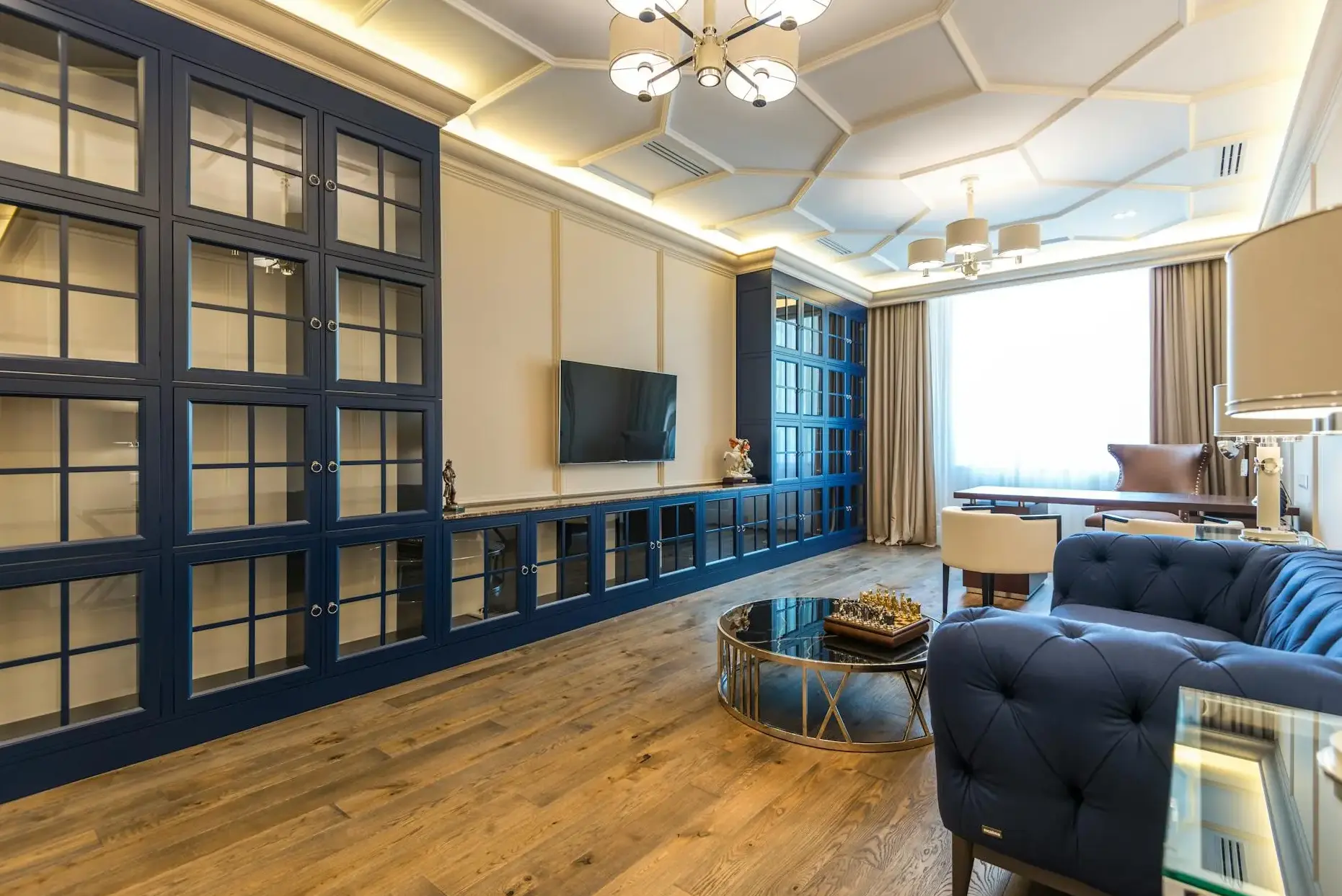
Custom built-in cabinetry is what separates a luxury home office from a room with furniture in it. Built-ins provide storage, display space, and architectural character while also serving a practical function: creating a professional background for video calls.
The camera wall: This is the wall that appears behind you on video calls. Design it intentionally. The most effective camera walls feature built-in bookshelves (filled with actual books and a few curated objects), a rich paint color or wallcovering (navy, charcoal, deep green, or warm wood tones all photograph well), subtle accent lighting (LED strips behind shelves or small picture lights), and enough depth that the background is not flat and two-dimensional. Avoid open shelving that creates visual clutter. A combination of open and closed storage works best.
Materials: For luxury offices in Atlanta, popular wood choices include walnut (warm, contemporary), white oak (transitional), painted maple (traditional), and cherry (classic executive). Walnut and white oak are currently the most requested materials in Atlanta's high-end market, according to local custom cabinet shops. Budget $15,000 to $40,000 for a full wall of custom built-in cabinetry, depending on material, complexity, and finish level.
Desk integration: Many luxury offices incorporate the desk into the built-in design, with a stone or wood surface that spans between cabinetry sections. This creates a seamless, intentional look and eliminates the problem of a standalone desk that does not match the room's millwork. A built-in desk surface with integrated cable management, power outlets hidden in a desk drawer, and a pop-up monitor mount creates a workspace that looks clean when not in use and functions exceptionally well when you are working.
Resale Impact: What Buyers Are Looking For
The resale impact of a home office depends on two factors: how well it is executed and how easily it can be repurposed. The best luxury home offices are designed to be obviously useful as an office while also being convertible to other functions (library, sitting room, additional bedroom) if a future buyer does not need dedicated office space.
In the $1 million+ price range, homes with dedicated main-level offices tend to sell faster than comparable homes without one. The appeal is particularly strong for homes in executive-heavy neighborhoods like Buckhead, Sandy Springs, and Brookhaven, where a significant percentage of buyers work in finance, consulting, or corporate leadership roles that involve frequent video calls.
What adds the most value: a main-level location (not buried in the basement), a proper door (not an open nook), built-in cabinetry, good natural light, and visible attention to finish quality. What can actually hurt value: converting a bedroom in a way that cannot be reversed (reducing the bedroom count below market expectations), installing highly personalized or themed elements that a new buyer would want to remove, or creating an office that is so specialized it feels like a commercial space rather than a room in a home.
If you are preparing to sell your Atlanta luxury home, staging the office matters. Show it as a functional workspace with clean surfaces, minimal personal items, and a setup that helps buyers envision themselves working there. Remove stacks of papers, personal photos, and anything that makes the space feel cluttered or too personalized.
Building an Office That Works as Hard as You Do
A well-designed home office in a luxury home is an investment in your daily productivity, your professional image, and your home's long-term value. The difference between a great office and a mediocre one comes down to planning: getting the soundproofing, lighting, technology, and cabinetry right before you move in, rather than patching things together after the fact.
The total investment for a properly outfitted luxury home office in Atlanta runs $25,000 to $75,000 for most projects, with the top end reserved for full custom builds with premium materials and acoustic treatment. Relative to the total value of a $1.5 to $3 million home, this is a modest investment that pays dividends every working day and adds measurable resale value.
Whether you are buying a home with office needs in mind or upgrading your current space, our team can help you evaluate properties for work-from-home suitability and connect you with designers and contractors who specialize in luxury residential offices. Get in touch with us to discuss what you need.
Frequently Asked Questions
Does a dedicated home office add resale value to a luxury home?
Yes. According to the National Association of Realtors' 2024 Profile of Home Buyers and Sellers, 47% of buyers reported working from home at least part-time, and a dedicated home office was listed among the top 5 most desired features. Homes with a purpose-built office (not a converted bedroom) typically command a premium of 3% to 5% over comparable homes without one in the Atlanta luxury market. The key is quality of execution. A professionally designed office with built-in cabinetry, proper lighting, and soundproofing adds significantly more value than a spare bedroom with a desk.
What is the ideal size for a luxury home office?
For a single-occupant executive office, 150 to 250 square feet works well. This provides space for a 72-inch or larger desk, a credenza, a seating area for one or two visitors, and built-in bookshelves or storage. For a dual-occupant office (common for couples who both work from home), plan for 250 to 400 square feet. If you need a separate video conferencing area or a small conference table, you may need 300 to 500 square feet. Many luxury homes in Atlanta are converting formal living rooms or dining rooms into offices, which typically provides 200 to 350 square feet of well-proportioned space.
How much does it cost to build a luxury home office?
A full build-out of a luxury home office in Atlanta typically costs $25,000 to $75,000, depending on scope. Basic conversion of an existing room (paint, lighting, built-in desk, upgraded electrical) runs $15,000 to $30,000. A complete build with custom cabinetry, soundproofing, dedicated HVAC zone, premium lighting, and technology infrastructure runs $40,000 to $75,000 or more. The highest-end offices with walnut or cherry paneling, integrated AV systems, and acoustic treatment can exceed $100,000. These costs do not include furniture, which can add $5,000 to $30,000 for a luxury desk, chair, and seating area.
How do you soundproof a home office?
Effective soundproofing involves multiple layers. Start with the walls: add mass-loaded vinyl (MLV) behind drywall, use resilient channels to decouple the drywall from framing, and fill wall cavities with acoustic insulation (like Roxul Safe'n'Sound). For the door, replace hollow-core doors with solid-core doors (at minimum 1 3/4 inches thick) and add perimeter gaskets and a door bottom seal. For windows, dual-pane or triple-pane windows with laminated glass provide significant sound reduction. Acoustic ceiling treatments and area rugs or carpet reduce echo within the room. A professionally soundproofed office typically achieves an STC (Sound Transmission Class) rating of 50 to 60, which blocks most conversational noise.
What lighting is best for video calls?
The best lighting for video calls comes from in front of and slightly above the face. Avoid overhead-only lighting (creates harsh shadows under the eyes) and backlighting from windows behind you (makes you appear as a silhouette). The ideal setup includes: a key light at roughly 45 degrees from your face (either a dedicated LED panel or well-positioned task light), fill light on the opposite side to soften shadows, and controlled ambient light in the room. Many luxury home offices now include tunable LED fixtures (adjustable color temperature from warm 2700K to cool 5000K) that can shift from comfortable working light to optimal video call lighting with a single switch or app adjustment.
What technology infrastructure does a luxury home office need?
At minimum: hardwired Ethernet (Cat6a or better) to the desk location, at least two dedicated 20-amp electrical circuits (one for equipment, one for lighting/HVAC), a dedicated Wi-Fi 6E or Wi-Fi 7 access point for the office zone, and a UPS (uninterruptible power supply) rated for your equipment load. Beyond that, consider: a whole-home mesh network with a wired backhaul, a network switch at the desk for multiple wired connections, pre-wired conduit for future technology upgrades, and smart home integration for lighting, shades, and climate control. Cable management should be built into the cabinetry design so that wires are never visible.
Should I convert a bedroom or a formal living room into an office?
Both can work, but the best choice depends on your home's layout and your needs. Converting a formal living room offers several advantages: it is typically on the main floor (convenient for daily use), has larger windows (better natural light), and is separate from the bedroom wing (better sound isolation from family activities). The drawback is losing a room that some buyers expect to see. Converting a bedroom preserves the main-level layout but may be farther from the home's entry if you receive clients. For resale, a main-level office that can easily revert to a formal room is generally the safest approach.
What desk size and setup works best for dual monitors?
For a dual-monitor setup with a 27-inch primary and 27-inch secondary monitor, you need at minimum 60 inches of desk width. A 72-inch desk provides comfortable spacing plus room for a laptop, phone, and writing space. Desk depth should be at least 30 inches to allow proper viewing distance (20 to 26 inches from the monitors to your eyes, per OSHA ergonomic guidelines). Many luxury offices use an L-shaped or U-shaped configuration with the monitors on the primary surface and a return for spreading out documents or hosting a laptop for clients. Consider a motorized sit-stand desk frame with a custom wood or stone top that matches the room's millwork.
How important is a separate HVAC zone for a home office?
Very important for comfort and productivity. A home office generates heat from electronics (a desktop computer, two monitors, and a printer can produce 500 to 800 watts of heat), and south or west-facing offices in Atlanta can overheat on sunny afternoons even when the rest of the house is comfortable. A separate HVAC zone (or a mini-split unit) allows you to control temperature independently. This is especially important for video calls, where visible perspiration or discomfort is noticeable. The cost to add a dedicated mini-split for a home office is typically $3,000 to $6,000 installed.
What background looks best on video calls for professionals?
Research from Cornell University and virtual meeting platform studies consistently shows that the most credible video call backgrounds feature built-in bookshelves with actual books, warm but not distracting colors (navy, charcoal, deep green), subtle artwork or a single statement piece, and good depth (the background should not be flat against the wall behind you). Avoid overly busy backgrounds, personal photos visible to clients, bright windows, and blank white walls. Many luxury home offices now include a designed 'camera wall' that is specifically styled for video calls, with controlled lighting, curated shelving, and a color palette that complements the occupant's skin tone.
Looking for a luxury home with great office potential?

Sources
- National Association of Realtors (NAR) - 2024 Profile of Home Buyers and Sellers, home office demand data, and buyer preference surveys.
- Atlanta Realtors Association - Days on market data and price premium analysis for homes with dedicated offices in the Atlanta luxury market.
- OSHA - Ergonomic guidelines for computer workstation setup, monitor distance, and desk height recommendations.
- ASTM International - Sound Transmission Class (STC) testing standards and acoustic performance ratings for building assemblies.
- Cornell University - Research on video call backgrounds and professional perception in virtual meetings.
- Department of Energy - Lighting efficiency standards, color temperature recommendations, and smart home integration guidelines.
Cost estimates, product specifications, and market data referenced in this article reflect conditions in the Atlanta metro area as of early 2026 and are subject to change. This article does not constitute design, construction, or financial advice. Consult with qualified professionals for guidance specific to your project.
Disclaimer: This article is for informational purposes only and does not constitute design, construction, tax, or financial advice. Cost estimates are approximate and vary based on project scope, materials, and contractor. Resale value impacts are based on market data and are not guaranteed. Tax deduction eligibility for home offices depends on individual circumstances and IRS rules. The Luxury Realtor Group is a real estate brokerage and does not provide design, construction, or tax services. Consult with qualified professionals before making renovation or purchase decisions.