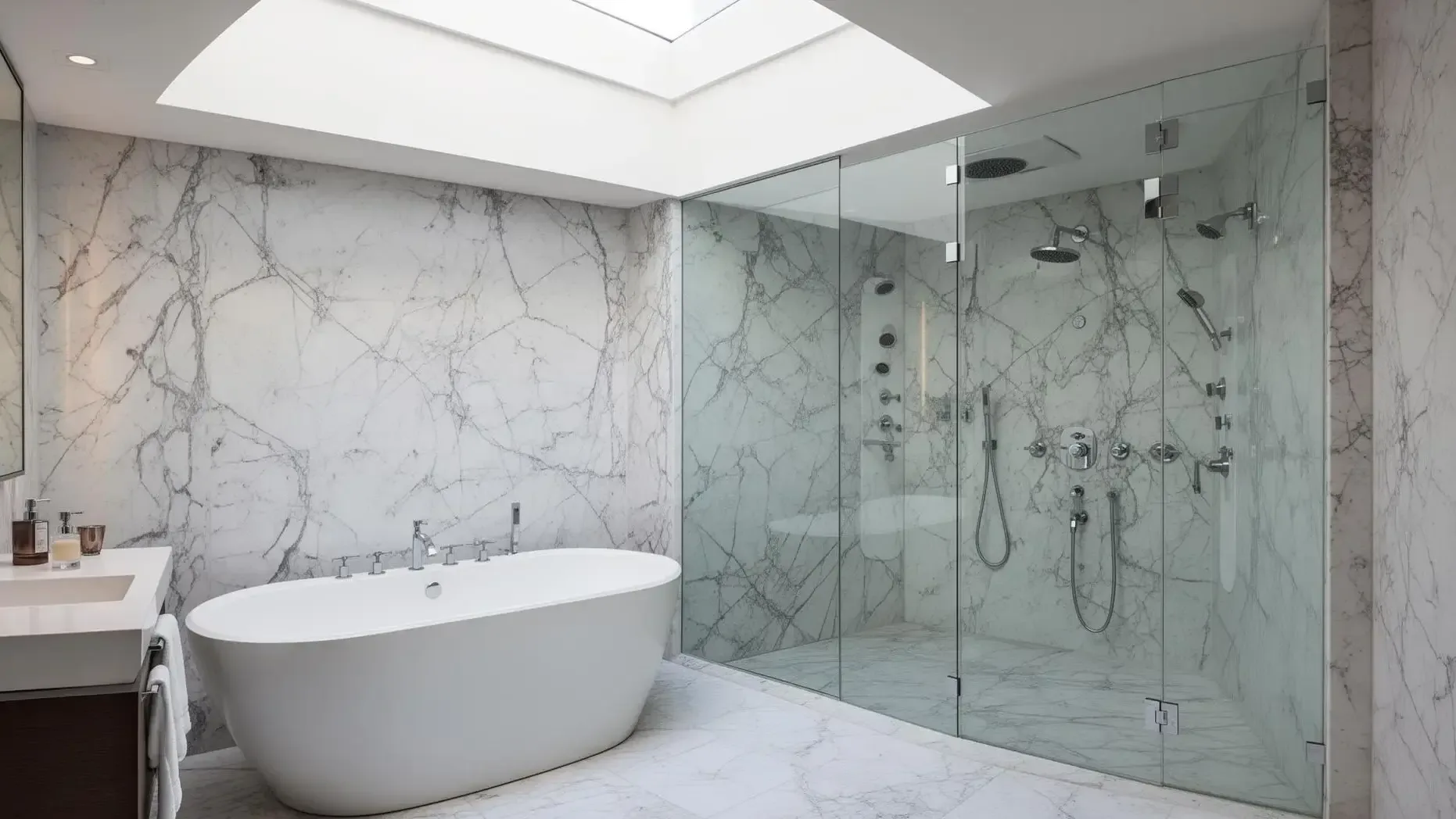
The primary bathroom has become one of the most important rooms in a luxury home. It is no longer just a functional space. For buyers and homeowners in the Atlanta market spending $1 million and above, the primary bath is expected to feel like a personal spa, a retreat from the pace of daily life. And when that bathroom falls short of expectations, it can cost you real money at resale.
According to the National Association of Home Builders (NAHB), the primary bathroom consistently ranks among the top three rooms that influence a buyer's purchasing decision. In Atlanta's luxury market, where homes in Buckhead, Sandy Springs, and Brookhaven regularly sell above $1.5 million, an outdated primary bath is one of the fastest ways to lose buyer interest.
This guide covers everything you need to know about planning and executing a luxury bathroom renovation in Atlanta: current design trends, material choices, cost ranges by scope, expected ROI, contractor selection, and realistic timelines. Whether you are renovating to sell or renovating to stay, the decisions you make here will have lasting impact on both your daily life and your home's market value.
Primary Bathroom Design Trends in 2026
The luxury bathroom in 2026 takes its cues from high-end hotel and resort design. The goal is a space that feels serene, uncluttered, and built around natural materials. Here is what we are seeing across the Atlanta market in new construction and high-end renovations.
Spa-forward design. The dominant aesthetic is a warm, organic spa feel. Think natural stone (honed marble, travertine, limestone), warm wood tones in cabinetry and accent walls, and a palette that leans toward soft whites, warm grays, and earth tones. The cold, all-white, overly modern bathroom that was popular five years ago has given way to something warmer and more layered. Designers in Atlanta are pulling from Japanese soaking bath traditions, Scandinavian minimalism, and Mediterranean stone work to create bathrooms that feel calm and intentional.
Large-format surfaces. One of the biggest shifts in luxury bathroom design is the move toward large-format porcelain slabs and natural stone panels. Instead of 12x24 tiles with visible grout lines, designers are specifying 48x96 or even 60x120 panels that cover entire walls with minimal joints. The result is a cleaner, more seamless look that is also easier to maintain. Brands like Neolith, Dekton, and large-format porcelain manufacturers have made this feasible at price points that work within luxury budgets.
Fixture finishes. Matte black remains popular in transitional and contemporary Atlanta homes, but brushed gold and burnished brass have gained significant ground. Polished nickel is making a comeback for more traditional aesthetics. The trend is moving away from chrome, which now reads as more builder-grade in the luxury segment. Most high-end renovations coordinate a single finish across faucets, showerheads, towel bars, and hardware for a cohesive look.
Smart technology integration. Digital shower systems that allow you to preset water temperature and flow with a touchscreen or voice control are becoming standard in luxury builds. Heated toilet seats with bidet functions (brands like Toto Washlet and Kohler Numi) are increasingly requested. Motion-activated faucets, lighted mirrors with defogging and Bluetooth, and built-in speakers are all features that luxury buyers in Atlanta have come to expect.
Freestanding Tubs, Walk-In Showers, and Steam Rooms
The two anchoring features of a luxury primary bathroom are the tub and the shower. How you handle these two elements will define the look, function, and value of the space.
Freestanding tubs remain the dominant choice for luxury primary bathrooms in Atlanta. They serve as a visual centerpiece, and the best ones are positioned near a window for natural light or against an accent wall. Materials range from cast iron (classic, heavy, excellent heat retention) to natural stone (stunning but very heavy, typically requiring reinforced subfloor) to engineered composite (lightweight, warm to the touch, wide range of shapes). Popular brands in the Atlanta luxury market include Victoria + Albert, Badeloft, and Native Trails. Expect to spend $3,000 to $15,000 for the tub itself, with installation adding $1,000 to $3,000.
Walk-in showers have replaced the tub as the primary bathing space in most luxury homes. The standard configuration in a high-end Atlanta renovation includes a frameless glass enclosure (3/8" or 1/2" glass), a rain showerhead (10" to 16" diameter), a handheld spray, at least one bench or seat, and one or two niches for storage. Curbless (zero-threshold) entries are the preferred design for both aesthetics and accessibility, though they require careful waterproofing and proper floor pitch. According to the National Kitchen and Bath Association (NKBA), walk-in showers with curbless entries are the most requested shower feature in luxury renovations nationwide.
Steam showers add a true spa element and appeal to a subset of luxury buyers. A residential steam generator (brands like MrSteam and ThermaSol) costs $2,000 to $6,000 for the unit, with installation running $1,500 to $4,000 depending on your existing infrastructure. The shower enclosure must be fully sealed (floor to ceiling) to contain the steam, which means additional waterproofing and a sloped ceiling to direct condensation. A steam shower adds a premium feel and can be a differentiator at resale, but it is not a universal must-have in the same way a walk-in shower is.
Heated Floors and Comfort Features
Radiant floor heating has moved from luxury add-on to expected feature in high-end Atlanta bathroom renovations. While Georgia winters are mild compared to the Northeast, stepping onto a warm tile floor on a 35-degree January morning is a tangible quality-of-life improvement that buyers notice.
Electric radiant floor systems (the most common choice for bathroom-only installations) use thin heating mats or cables installed directly under the tile. Major brands include Schluter Ditra-Heat, Nuheat, and WarmlyYours. The material cost for a 150-square-foot bathroom runs approximately $1,200 to $2,250, and installation adds $800 to $1,500. A programmable thermostat allows you to schedule the system to warm up before your morning routine and shut off during the day, keeping operating costs under $1 per day in most cases.
Other comfort features gaining traction in Atlanta luxury bathrooms include towel warmers (freestanding or wall-mounted, $200 to $1,500), heated mirrors with integrated LED lighting and defogging ($500 to $2,500), and ventilation systems that go beyond a basic exhaust fan. Panasonic WhisperCeiling fans and similar ultra-quiet models run at 0.3 to 1.0 sone, which is essentially inaudible, a notable upgrade from the noisy fans found in most older homes.
Renovating a Primary Bath Before Selling?
Material choices that photograph well do not always appraise well. A quick review before you order slabs can save an expensive detour.
Get a Value Read Before You Buildor call (770) 727-4052
Material Choices: Marble vs. Porcelain and Beyond
Material selection is where the budget really starts to move, and it is also where you make the most visible design decisions. In the Atlanta luxury market, these are the primary choices and what to know about each.
Natural Marble (Calacatta, Carrara, Statuario)
Marble is the gold standard for luxury bathrooms. Calacatta Gold, with its warm white base and dramatic gold and gray veining, is the most sought-after and typically costs $40 to $100 per square foot for slabs. Carrara is more subtle and accessible at $20 to $50 per square foot. Marble requires professional sealing every 1 to 2 years and is susceptible to etching from acidic products. It is best used on vanity tops, accent walls, and tub surrounds where it can be properly maintained. For shower floors, where standing water and soap residue are constant, many designers recommend porcelain instead.
Large-Format Porcelain
Modern porcelain technology has advanced to the point where large-format slabs can closely replicate the look of natural marble, wood, and concrete. Brands like Laminam, Sapien Stone, and Florim produce panels up to 60x120 inches that can cover entire walls with virtually no grout lines. Porcelain is non-porous, stain-resistant, and requires no sealing. It costs $15 to $50 per square foot depending on the brand and format. For shower walls and floors, it is the most practical choice in most luxury renovations.
Quartzite and Granite
Quartzite (not to be confused with engineered quartz) is a natural stone that is significantly harder than marble and more resistant to etching and staining. Taj Mahal quartzite, with its soft gold and cream tones, has become one of the most popular choices for luxury vanity tops in Atlanta. It typically costs $50 to $120 per square foot installed. Granite remains a durable option but has fallen somewhat out of favor in the highest-end segment, where marble and quartzite are preferred for their veining and visual warmth.
Decorative Tile and Mosaics
Handmade zellige tiles, waterjet-cut marble mosaics, and textured ceramic tiles are used as accent elements in luxury bathrooms. A mosaic feature wall behind a freestanding tub or a zellige tile backsplash above the vanity adds texture and visual interest. These specialty tiles range from $20 to $80 per square foot and are typically used sparingly (10 to 30 square feet) as accents rather than primary surfaces.
Cost Ranges by Scope in the Atlanta Market
Understanding what drives cost in a luxury bathroom renovation helps you make informed decisions about where to invest and where to hold back. According to data from the Remodeling Magazine Cost vs. Value Report and local contractor estimates for the Atlanta market, here are the typical ranges.
Atlanta Luxury Bathroom Renovation Cost Tiers
- Cosmetic refresh ($25,000 to $50,000): New tile in the shower and on floors, updated fixtures and hardware, new vanity tops, fresh paint, new mirrors and lighting. Same footprint, same layout, no plumbing moves. This tier works well for homes that are structurally sound but aesthetically dated.
- Mid-range luxury renovation ($50,000 to $100,000): Full gut to the studs, new layout within existing footprint, custom cabinetry, natural stone or premium porcelain surfaces, frameless glass shower, freestanding tub, heated floors, upgraded lighting. This is the most common scope for luxury homeowners in Buckhead and Sandy Springs who want a premium result without expanding the room.
- High-end full renovation ($100,000 to $200,000+): Expansion of the bathroom footprint, structural changes, premium natural stone throughout, custom millwork, steam shower, smart home integration, radiant heating, designer fixtures from brands like Waterworks, Brizo, or Dornbracht. This tier is typical for homes above $2 million where the primary bath is expected to be a showpiece.
ROI: What the Data Shows for Atlanta
The ROI conversation around bathroom renovations is more nuanced than simple cost-recovery math. According to Remodeling Magazine's 2025 Cost vs. Value Report, an upscale bathroom remodel recovers approximately 36% to 56% of its cost at resale in the South Atlantic region. That means a $100,000 renovation might add $36,000 to $56,000 in appraised value.
But that is only part of the picture. In Atlanta's luxury market, the real ROI of a bathroom renovation often shows up in three ways. First, it prevents price reductions. A dated primary bath in a $1.8 million home can easily trigger $50,000 to $100,000 in buyer-requested concessions. Second, it speeds up the sale timeline. Move-in ready luxury homes with updated primary bathrooms tend to sell faster than comparable homes with dated bathrooms. Third, it attracts higher-quality offers from buyers who are willing to pay a premium for a home that does not require immediate renovation.
If you are renovating to stay, the ROI calculation changes entirely. You will use the bathroom every day for years. The investment in quality materials, heated floors, and a well-designed shower pays dividends in daily comfort and enjoyment that do not show up on a spreadsheet. Many homeowners who renovate their primary bath say it was one of the best home improvement investments they made, regardless of the resale math.
Selecting the Right Contractor in Atlanta
The difference between a good luxury bathroom renovation and a disappointing one almost always comes down to the contractor. In the Atlanta market, there is a wide range of quality, and the cheapest bid is rarely the right choice for high-end work.
Start by verifying credentials. Georgia requires a general contractor license for projects above $2,500. Check the Georgia Secretary of State licensing database to confirm the contractor is current and in good standing. Verify they carry general liability insurance ($1 million minimum) and workers' compensation coverage. Ask for their certificate of insurance directly and confirm it with the insurance provider.
Experience with luxury-specific work matters. A contractor who primarily builds production homes or handles insurance restoration work may not have the skill set for precision tile work, custom cabinetry installation, or complex waterproofing. Ask to see at least three completed luxury bathroom projects in the Atlanta area. Visit at least one in person if possible. Pay attention to tile layout and alignment, grout consistency, caulk lines, and the quality of trim and finish work.
Get detailed, itemized bids from at least three contractors. A vague lump-sum bid is a red flag. You want to see line items for demolition, plumbing, electrical, framing (if applicable), waterproofing, tile and stone installation, cabinetry, fixtures, glass, lighting, paint, and general conditions (permits, dumpster, cleanup). This level of detail makes it possible to compare bids accurately and to manage change orders during the project.
Timeline discipline is another indicator of quality. A reputable luxury contractor in Atlanta will give you a detailed project schedule with milestones and will communicate proactively about delays. The best contractors are booked 2 to 4 months ahead, so plan accordingly, especially if you are renovating before listing your home for sale.
The Bottom Line
A luxury bathroom renovation is one of the most impactful improvements you can make to an Atlanta home. The primary bath sets the tone for how a home feels, and in the luxury market, buyers expect a space that is both beautiful and thoughtfully designed.
The most successful renovations start with a clear plan: define your budget, choose your materials with both aesthetics and maintenance in mind, and hire a contractor whose work you have seen and verified. Whether you are investing $50,000 in a targeted refresh or $150,000 in a full transformation, the return comes in both market value and daily quality of life.
If you are planning a bathroom renovation before selling your Atlanta luxury home, or if you are looking for a new home where the primary bath is already done right, reach out to our team. We work with buyers and sellers across Buckhead, Sandy Springs, Brookhaven, and all of metro Atlanta's top luxury neighborhoods, and we can help you make smart decisions about where to invest.
Frequently Asked Questions
How much does a luxury bathroom renovation cost in Atlanta?
A luxury primary bathroom renovation in Atlanta typically ranges from $50,000 to $150,000 or more, depending on scope, materials, and layout changes. A cosmetic refresh with new tile, fixtures, and paint may run $30,000 to $50,000. A full gut renovation with layout changes, custom cabinetry, heated floors, and premium stone can exceed $100,000. According to the National Association of Home Builders, the primary bathroom is one of the highest-priority renovation areas for luxury homeowners, and costs in the Atlanta market tend to be 10% to 20% lower than comparable projects in Northeast or West Coast cities.
What is the ROI on a luxury bathroom remodel?
According to Remodeling Magazine's annual Cost vs. Value Report, an upscale bathroom remodel recovers approximately 36% to 56% of its cost at resale nationally. However, ROI varies significantly based on the starting condition of the bathroom, the quality of work, and the local market. In Atlanta's luxury market, an outdated primary bath can be a deal-breaker for buyers. Renovating it may not return dollar-for-dollar at sale, but it can prevent price reductions and speed up the sale timeline. The real value is often in marketability rather than a strict cost-recovery calculation.
Is marble or porcelain better for a luxury bathroom?
Both are used extensively in Atlanta luxury homes, and the choice depends on your priorities. Natural marble (Calacatta, Carrara, Statuario) offers unmatched beauty and a premium feel but requires regular sealing and is more prone to staining and etching. Porcelain tiles now come in large-format slabs that convincingly replicate marble at a fraction of the maintenance. For shower floors and wet areas, many designers recommend porcelain for durability and marble for accent walls, vanity tops, and dry areas where the material can be properly maintained.
How long does a luxury bathroom renovation take?
A full luxury primary bathroom renovation in Atlanta typically takes 8 to 16 weeks from demolition to completion, depending on scope. Custom cabinetry, imported tile, and specialty fixtures can add lead time. If you are changing the layout (moving plumbing walls or adding square footage), plan for 12 to 20 weeks. The design and material selection phase before construction begins usually takes an additional 4 to 8 weeks. The best contractors in Atlanta are booked 2 to 4 months out, so plan accordingly.
Are heated bathroom floors worth the investment?
Radiant floor heating is one of the most requested features in Atlanta luxury bathroom renovations. The cost for electric radiant mats under tile typically runs $8 to $15 per square foot for materials, plus installation. For a 150-square-foot primary bath, that is roughly $1,200 to $2,250 in materials. Operating costs are modest, typically $0.50 to $1.00 per day for a few hours of use. Buyers in the luxury market increasingly expect heated floors, and the feature consistently ranks high in buyer preference surveys from the National Association of Home Builders.
Should I choose a freestanding tub or a built-in tub?
Freestanding tubs have dominated luxury bathroom design for the past decade and remain popular in 2026. They serve as a visual centerpiece and work well in larger bathrooms where they can be positioned near a window or in the center of the room. Built-in or platform tubs offer more practical soaking depth and can integrate seamlessly with surrounding tilework. The trend in Atlanta luxury homes is increasingly toward sculptural freestanding tubs in natural stone or matte finishes, but the best choice depends on your bathroom's layout and how frequently the tub will actually be used.
What shower features do luxury buyers expect in Atlanta?
Walk-in showers have become the primary bathing space in most luxury primary bathrooms. Buyers in the Atlanta market expect frameless glass enclosures, multiple showerheads (rain head plus handheld), a bench or seat, and a curbless or low-threshold entry. Steam shower capability is a premium add-on that appeals to about 30% of luxury buyers, per builder surveys. Body jets, digital temperature controls, and built-in niches with accent lighting are also common requests in the $1.5 million and above price range.
How do I find a reliable luxury bathroom contractor in Atlanta?
Start with referrals from your real estate agent, interior designer, or neighbors who have completed similar projects. Look for contractors who specialize in high-end residential work, not general remodelers who occasionally take on luxury projects. Verify their Georgia contractor license, insurance, and ask for references from at least three recent luxury projects. The National Association of the Remodeling Industry (NARI) and the National Kitchen and Bath Association (NKBA) are good credential sources. In Atlanta, expect to interview 3 to 5 contractors before selecting one.
Do double vanities increase home value?
In the luxury market, double vanities in the primary bathroom are effectively a requirement, not a bonus. Buyers in the $750,000 and above price range in Atlanta almost universally expect separate sinks, and the absence of a double vanity can be a significant negative. Beyond basic double sinks, luxury buyers look for generous counter space, soft-close drawers, under-cabinet lighting, and dedicated outlets and storage for grooming tools. His-and-hers vanity areas with separate mirrors are common in higher-end renovations.
What bathroom design trends are popular in Atlanta luxury homes in 2026?
Several trends are gaining traction in Atlanta luxury bathroom renovations in 2026. Spa-inspired design with natural materials (wood tones, stone, organic textures) continues to dominate. Large-format porcelain slabs that minimize grout lines are replacing smaller mosaic tiles in many projects. Matte black and brushed gold fixtures remain popular, with polished nickel making a comeback. Backlit mirrors, curbless showers, and integrated smart features (heated toilet seats, motion-activated faucets, digital shower controls) are increasingly standard in the $2 million and above market.
Planning a luxury bathroom renovation in Atlanta?
Sources
- National Association of Home Builders (NAHB) - What Home Buyers Really Want survey data on bathroom feature preferences and priorities.
- Remodeling Magazine - 2025 Cost vs. Value Report, upscale bathroom remodel cost and resale value data for the South Atlantic region.
- National Kitchen and Bath Association (NKBA) - Annual design trends survey, shower and bath feature popularity rankings.
- FMLS (First Multiple Listing Service) - Atlanta luxury home sales data, days on market statistics, and pricing trends.
- Georgia Secretary of State - Contractor licensing verification and regulatory requirements for residential construction.
- National Association of the Remodeling Industry (NARI) - Contractor certification standards and consumer resources.
Cost estimates and market data referenced in this article reflect conditions in the metro Atlanta market as of early 2026 and are subject to change. Actual renovation costs will vary based on scope, materials, contractor, and site conditions. This article does not constitute financial or investment advice. Consult qualified professionals before making renovation decisions.
Disclaimer: This article is for informational purposes only and does not constitute financial, investment, or professional contracting advice. Renovation costs, timelines, and ROI figures are estimates based on market data and may vary based on individual circumstances. The Luxury Realtor Group is a real estate brokerage and does not provide contracting or interior design services. Always consult with licensed contractors, designers, and financial professionals before undertaking major renovations.